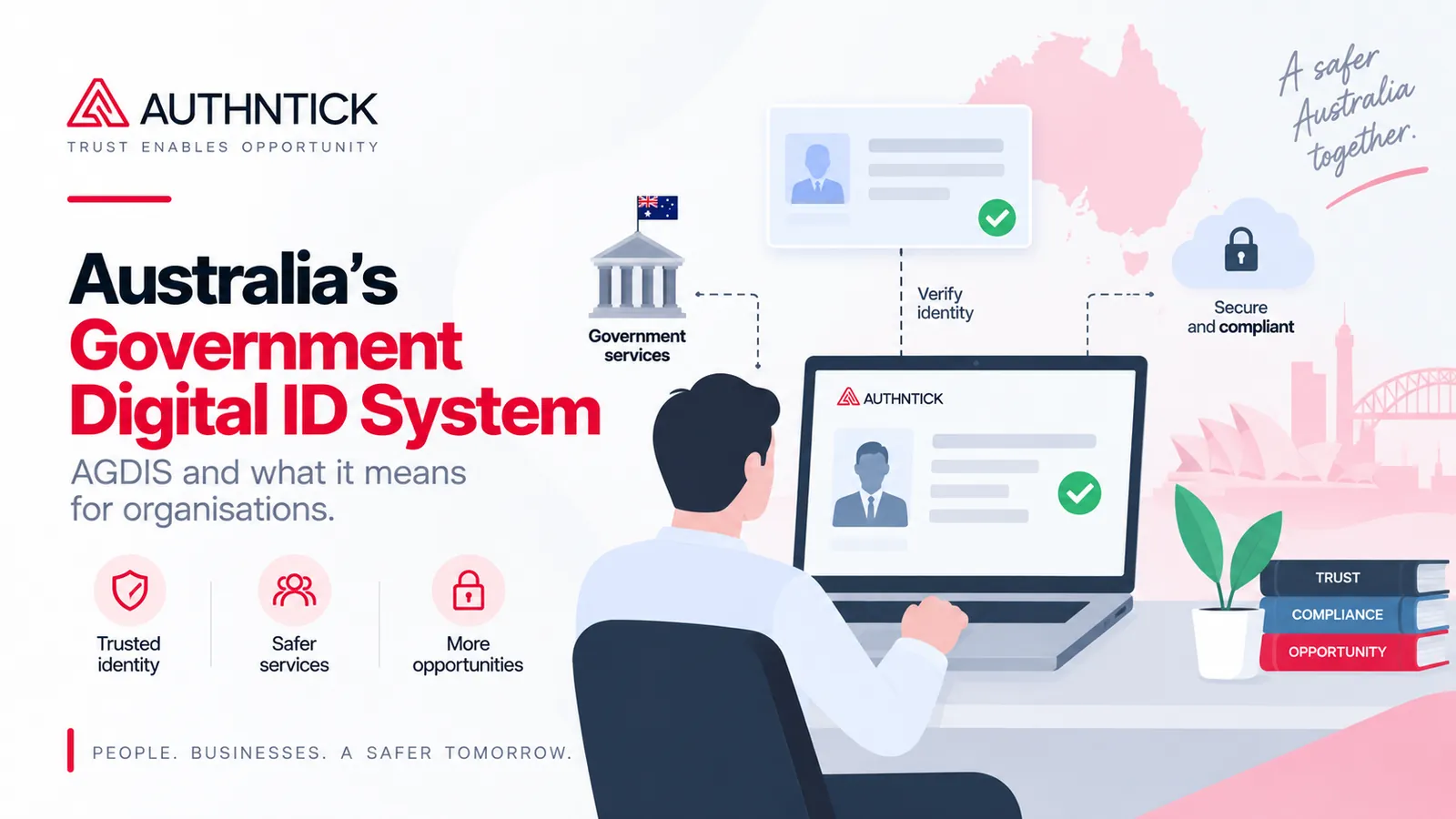
The Australian Government Digital ID System (AGDIS) is designed to help individuals verify their identity online in a safer and more privacy-conscious way. Instead of repeatedly uploading copies of identity documents, users can consent to share only the specific verified identity attributes required for a service.
In the context of employment screening or a Nationally Coordinated Criminal History Check, AGDIS can support a more secure and efficient identity verification process. The system operates under a federated framework, where identity information can be verified without unnecessarily exposing raw document data to every service provider.
Key Roles in the AGDIS Workflow
The following example explains how the workflow may operate where John is the individual, AuthNTick is the relying party, and Alice manages business authorisations through RAM.
- The User: John is the individual who wants to complete an online identity verification or background screening process.
- The Relying Party: AuthNTick is the service provider that requests verified identity attributes so it can provide a background screening service.
- The Digital ID Provider: A provider such as myID helps John prove and manage his Digital ID.
- The Identity Exchange: The exchange facilitates secure information flow between the Digital ID provider, attribute service providers and the relying party.
- The Business Authorisation Manager: Alice may use the Relationship Authorisation Manager (RAM) to authorise John to act on behalf of a business.
Step 1: John Starts the Verification Request
John visits AuthNTick to complete a background screening check, such as a Nationally Coordinated Criminal History Check or an employment screening check.
Instead of uploading scanned copies of his passport, driver licence or other identity documents, John selects an option such as Verify with Digital ID. This allows the identity verification process to occur through the Digital ID framework.
Step 2: AuthNTick Requests Only the Required Attributes
AuthNTick, as the relying party, requests only the identity attributes needed to complete the check. These may include details such as John's full name, date of birth and other required identity information.
This supports the principle of data minimisation. Rather than collecting and storing unnecessary raw identity documents, AuthNTick receives only the verified information required for the service.
Step 3: John Authenticates Through His Digital ID
John is redirected to authenticate using an accredited Digital ID provider, such as myID. The level of verification required depends on the service and the required identity strength.
- Standard identity strength: John may verify his identity using accepted identity documents and previously verified information.
- Strong identity strength: John may be required to complete additional verification, such as photo or biometric verification, depending on the provider and the service requirements.
The important point is that John authenticates through the Digital ID system, rather than repeatedly sending raw copies of identity documents to each service provider.
Step 4: Alice Manages Business Authorisation Through RAM
If John is completing the check on behalf of a company, a business authorisation step may be required. This is where RAM can be used.
Alice, as a principal authority or authorisation administrator for the business, can use RAM to authorise John to act on behalf of that business. This confirms that John has permission to access relevant online services or complete authorised tasks for the organisation.
For example, Alice may authorise John to manage screening tasks or share required business-related identity attributes for a specific organisation. This helps ensure that the person acting for the business has the correct authority to do so.
Step 5: John Gives Consent and Verified Data Is Released
Once John reviews the request and gives consent, the Digital ID system can send a secure response back to AuthNTick. This response may confirm verified identity attributes such as John's name and date of birth.
AuthNTick can then use the verified information to continue the background screening process without needing to store unnecessary copies of John's passport, driver licence or other sensitive identity documents.
Why This Matters for Background Screening
Using the Australian Government Digital ID System can make background screening safer, faster and more privacy-conscious. It reduces manual document handling, lowers the risk of identity document exposure and provides a more streamlined experience for candidates, employers and screening providers.
For organisations, this can improve compliance and reduce friction in onboarding workflows. For individuals, it provides a more secure way to prove who they are while sharing only the information required for the service.
Conclusion
AGDIS provides a modern framework for digital identity verification in Australia. In a background screening scenario, it allows a person like John to verify his identity through a trusted Digital ID provider, allows a relying party such as AuthNTick to receive only the required verified attributes, and allows business representatives such as Alice to manage authorisations through RAM where business access is required.
The result is a more secure, efficient and privacy-focused approach to identity verification for employment screening and related background check services.
Frequently Asked Questions About Digital ID and Background Checks
What is the Australian Government Digital ID System?
The Australian Government Digital ID System is a secure framework that allows individuals to verify their identity online and share only the required verified information with approved services.
Do I have to use Digital ID?
No. Using a Digital ID is optional. Individuals can still access many services through other available channels, such as phone, in-person or existing online processes.
What is myID?
myID, formerly known as myGovID, is the Australian Government's Digital ID app. It helps individuals prove who they are when accessing participating government and business services online.
What is RAM used for?
The Relationship Authorisation Manager (RAM) allows a business to authorise a person to act on its behalf when accessing participating online services.
What is the difference between an ISP, ASP and IXP?
An Identity Service Provider creates and manages a person's Digital ID. An Attribute Service Provider verifies specific information, such as date of birth or licence status. An Identity Exchange Provider helps securely route information between participants.
How can Digital ID help with background checks?
Digital ID can make background checks faster and safer by reducing the need to manually upload identity documents. It allows verified identity attributes to be shared securely with consent.
Is Digital ID regulated in Australia?
Yes. The Digital ID Act 2024 sets the legal framework for Digital ID in Australia. Accredited providers are expected to meet standards for privacy, cyber security, fraud control and related obligations.
Need Help With Secure Background Checks?
Request your Nationally Coordinated Criminal History Check, AFP Police Check or employment background screening through AuthNTick. Our online platform helps individuals and organisations complete checks quickly, securely and with privacy in mind.

About the author
Rahul Tripathi
Engineering and technology contributor
Rahul Tripathi is an engineer with interests in computer networks, digital systems and applied technology. At AuthNTick, he contributes to guides about digital identity, verification technology and practical screening workflows.
Editorial references
Official and authoritative sources
Use these primary and authoritative references to confirm current requirements for the topic covered in this guide.
- The Australian Government Digital ID System Australian Government Digital ID System
- Digital ID Act 2024 Australian Government Digital ID System
- Identity verification services IDMatch, Australian Government
- What is personal information? Office of the Australian Information Commissioner
This guide is general information, not legal advice. Government processes and employer requirements can change, so check the linked source and the requesting organisation’s instructions before acting. Read our editorial and corrections policy.
Next step
Ready to move from research to action?
Use AuthNTick to complete secure Australian background checks, or speak with our team if you need the right workflow for your organisation.