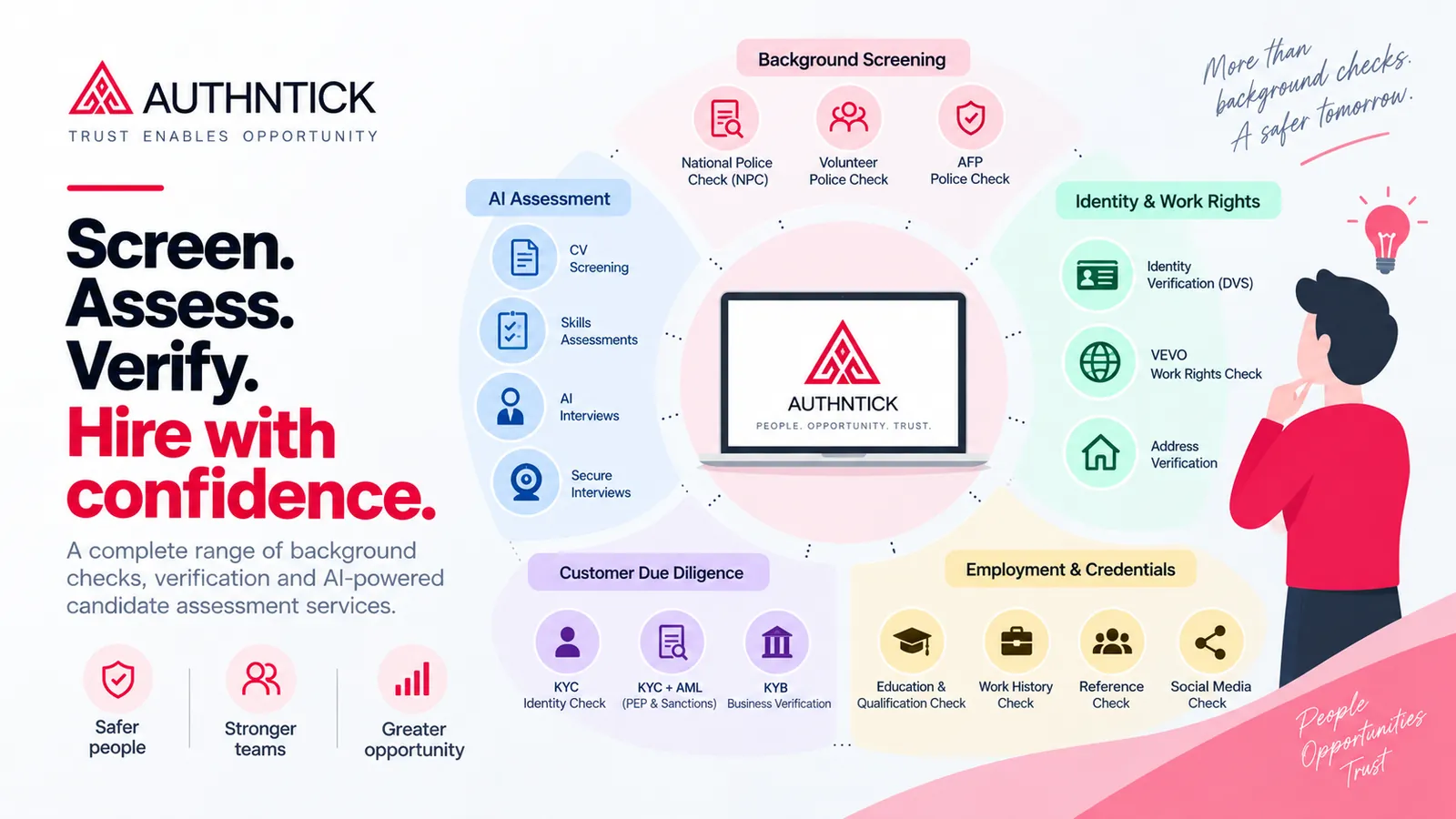
AuthNTick brings background screening, identity verification, candidate assessment and customer due diligence into connected digital workflows.
Organisations can use individual checks or combine relevant services around the requirements of a role, customer or business relationship. This includes criminal history, identity and work rights, employment and credentials, additional workforce screening, KYC customer identity, AML screening, KYB business verification and AI-assisted candidate assessment.
The appropriate checks depend on the purpose, role, industry and applicable legal or regulatory requirements. Not every person needs every check: keep screening lawful, relevant and proportionate, explain how personal information will be used and obtain appropriate consent. See the pre-employment screening guide for role-based planning.
Background checks currently available through AuthNTick
The following services have dedicated product pages. The evidence collected and verification method depend on the selected check and configured workflow.
Criminal history
Nationally Coordinated Criminal History Check
Australian criminal history screening for eligible employment, licensing and positions of trust. AuthNTick is an ACIC-accredited body that facilitates eligible checks through the nationally coordinated service; the ACIC and Australian police agencies have distinct roles in that service. Read the ACIC accreditation guide for more detail.
The result is a point-in-time record, subject to applicable disclosure rules. The requesting organisation decides whether it is sufficiently current and relevant, and makes the final employment or engagement decision.
View Nationally Coordinated Criminal History Check
Volunteer Police Check
The Nationally Coordinated Criminal History Volunteer Check provides a reduced-fee pathway for eligible unpaid volunteer, student placement and not-for-profit roles. Eligibility depends on the role and purpose; an unpaid placement is not automatically eligible. Confirm the requesting organisation’s requirements and provide supporting evidence where requested. This pathway must not be selected for paid employment simply to obtain a lower fee.
View Volunteer Police Check or read the student placement guide.
AFP Police Check
An AFP Police Check is issued by the Australian Federal Police and is commonly relevant to Commonwealth, Australian immigration, overseas visa and other AFP-specific purposes. Match the purpose and category to the receiving authority’s instructions. It is a point-in-time result and is not automatically interchangeable with the other criminal history pathways.
View AFP Police Check or read the AFP immigration guide.
Identity and work rights
DVS / Identity Verification Check
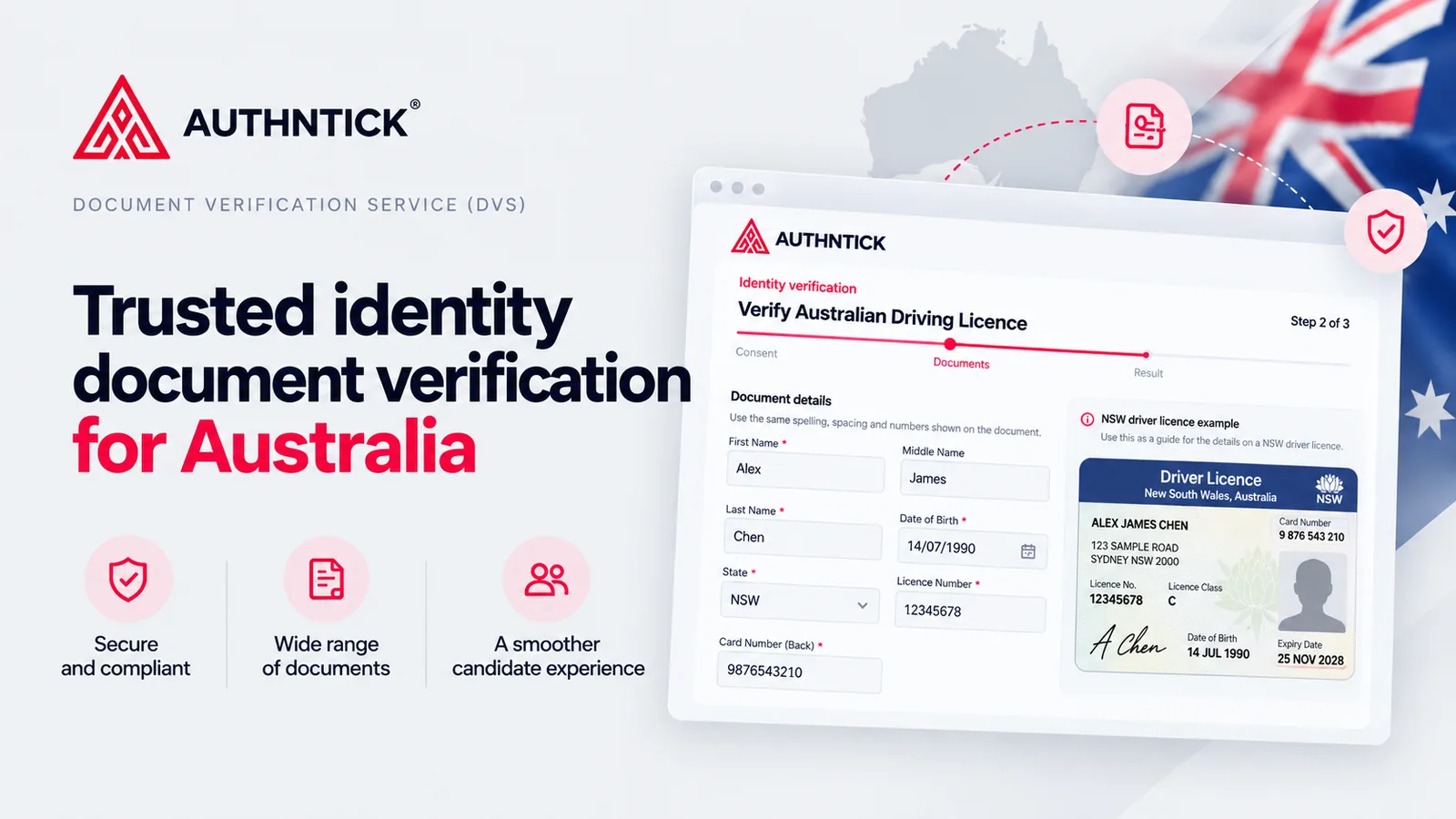
With candidate consent, the Document Verification Service (DVS) compares supported identity-document details with the issuing government record. Supported documents can include Australian driver licences, passports and Medicare cards, depending on the workflow.
A DVS match confirms that the supplied details match the issuing record. DVS alone does not prove that the presenter is the lawful document holder. AuthNTick’s identity workflow guides candidates through consent, document selection and verification.
View Identity Verification or read the DVS identity verification guide.
VEVO Work Rights Check
A consent-based VEVO check reports the visa status, subclass, work entitlement and relevant visa conditions available for a visa holder at the time of the check. It is a point-in-time result: status and conditions can change. VEVO does not replace identity verification or criminal history screening, and Australian citizens demonstrate their status through appropriate citizenship or identity evidence.
Address Verification Check
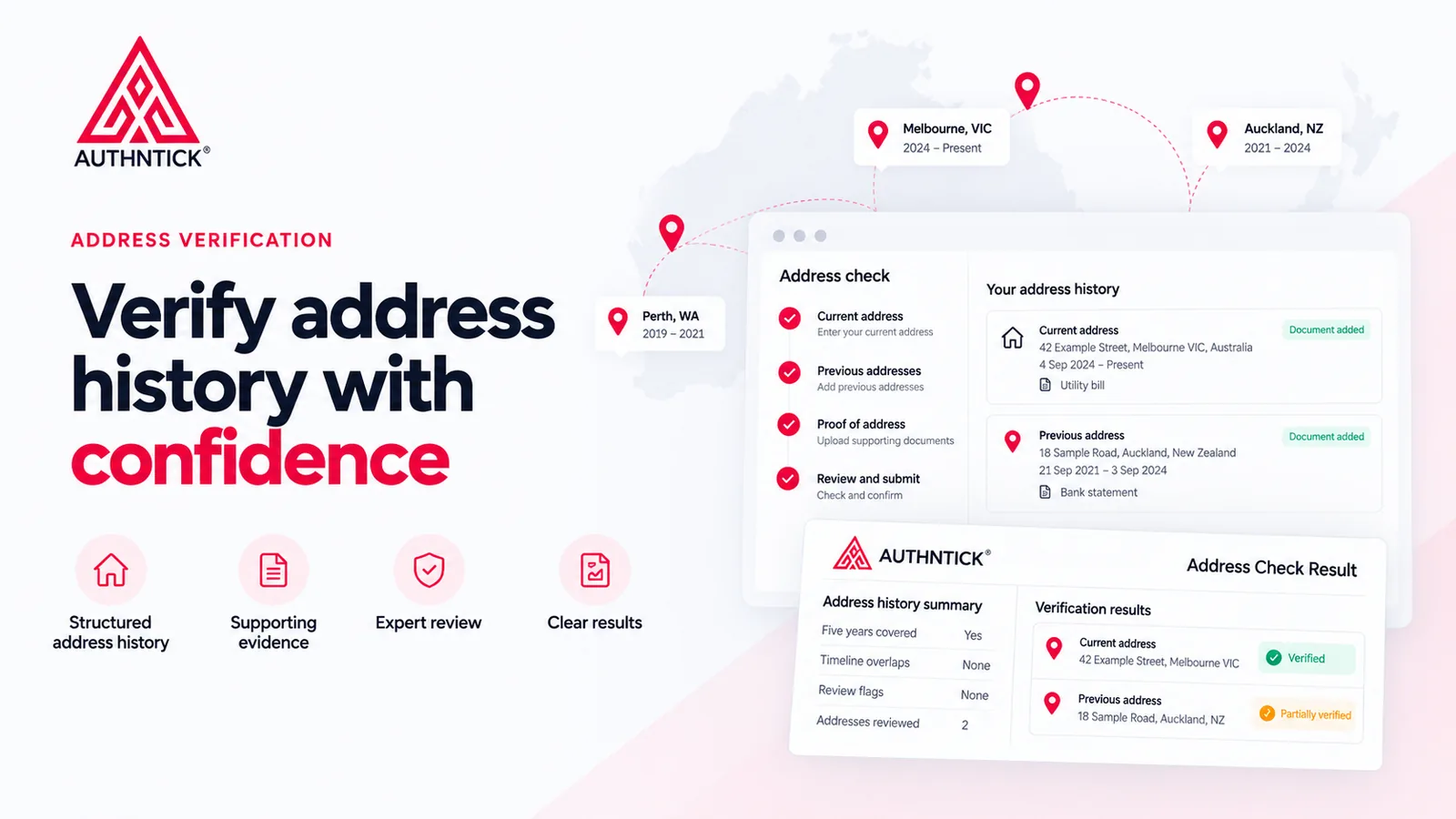
Collect current and previous residential addresses, residence dates and proof-of-address evidence. The workflow builds an address-history timeline and helps reviewers identify coverage, gaps or overlaps where applicable. Each address can have its own verification outcome, evidence record and reviewer notes.
Address API validation can recognise or resolve an address; it does not by itself prove the candidate lived there. Residence evidence still needs assessment.
View Address Verification or read the address history guide.
Employment and credential checks
Education & Qualification Check
Review a candidate’s claimed institution, qualification or award and relevant dates against available evidence. AuthNTick supports Australian and overseas qualification workflows, including certificates, transcripts and institution verification where available. Certified translations may be required for overseas documents; translation does not itself verify a qualification.
Field-level outcomes such as Match, Differs and Not shown distinguish supported details from differences or information absent from the source. The report records the evidence and limitations rather than implying every institution independently confirmed every field.
View Education & Qualification Check or read the education verification guide.
Work History Check
Factual employment verification compares candidate-provided employers, positions and employment dates with information supplied by an employer or authorised representative. Candidate claims and verifier responses remain distinguishable. Differences, unavailable information and timeline gaps are surfaced for review; a discrepancy or gap is not automatically an adverse finding.
View Work History Check or read the employment history verification guide.
Employer confirmation and alternative supporting evidence are different sources. If documents are reviewed where direct confirmation is unavailable, read the recorded method and limitations; candidate-supplied documents should not be treated as independent employer confirmation.
Reference Check
A Reference Check collects structured feedback from nominated referees about employment context, performance, conduct and suitability. Hiring teams can use a pre-built, custom or reviewed AI-generated questionnaire. Reports keep candidate-provided details separate from referee responses and identify discrepancies for consideration.
This differs from factual Work History Verification: referee statements and opinions are not automatically independently verified facts. AuthNTick presents the responses and limitations; the customer makes the hiring decision.
View Reference Check or read the professional reference check guide.
Social Media / Online Presence Check
Review role-relevant public online information through a structured, consent-based and privacy-aware process. Candidate-supplied identifiers and contextual details help match profiles, while uncertain attribution needs further review.
The check does not request passwords, enter private groups or bypass privacy settings. Public material can be outdated or misattributed. Customers remain responsible for fair employment decisions, including considering context and giving candidates an opportunity to respond to material concerns.
View Social Media Check or read the social media screening guide.
AI-assisted candidate assessment
Background verification asks whether relevant information can be verified. Candidate assessment asks a different question: what evidence does the candidate provide against the requirements of the role?
AuthNTick connects candidate screening, assessment and interviewing with background verification so hiring teams can move from claimed experience towards demonstrated capability and, where appropriate, independent verification.
CV Screening
AuthNTick analyses a candidate’s CV against role-specific criteria defined by the hiring team. These can include required experience, technical skills, qualifications, certifications, industry or leadership experience, technologies and platforms, and other requirements relevant to the work.
Review the criterion → assessment → supporting CV evidence together. The evidence statuses mean:
- Meets: relevant supporting evidence is present in the CV.
- Partially meets: some relevant evidence is present, but the requirement is not fully demonstrated.
- Not demonstrated: the CV does not contain sufficient evidence to establish the requirement.
“Not demonstrated” describes the available CV evidence. It does not mean that the candidate lacks the capability. Missing information may need clarification or a follow-up assessment. CV screening does not independently verify the claims or decide who should progress; the hiring team reviews the evidence.
Read the AI CV screening guide or explore CV Screening.
Skills Assessments
Skills Assessments help teams evaluate role-specific knowledge, capabilities, judgement and responses to realistic work scenarios. Teams can generate an editable assessment using AI, start with a pre-built template, or create and customise questions manually.
Supported question types include single choice, multiple select and written response. Review AI-generated questions, expected answers and scoring for relevance and clarity before sending the assessment. Results provide evidence and potential interview follow-up areas; a score should not automatically determine whether someone is hired or rejected.
Read the Skills Assessments guide or explore Skills Assessments.
AI Interviews
Eilo provides a structured interview in the candidate’s browser, asking role-relevant questions and follow-up questions, collecting responses and evaluating them against predefined scoring criteria. Authorised reviewers can examine the recording, transcript, score and supporting evidence.
AI Interviews provide another source of structured candidate evidence. Hiring teams remain responsible for reviewing responses and making recruitment decisions.
Explore AI Interviews with Eilo.
Secure Interviews
Secure Interviews support human-led interviews, with scheduling, candidate invitations, recording and an interview record. Teams can add documented interview integrity controls where required to support a controlled interview environment.
Explain the process and any recording or integrity controls to candidates, with appropriate consent and access arrangements. Integrity signals provide context for authorised review; they do not by themselves establish misconduct or determine suitability.
From application to verified hire
This is an illustrative workflow rather than a required sequence. Organisations can choose the screening and assessment stages appropriate to the role.
- CV Screening
- Skills Assessment
- AI Interview
- Reference Check
- Background Verification
- Hiring team decision
Claim · CV Screening
What experience, qualifications and skills does the application demonstrate?
Demonstrate · Skills Assessment + AI Interview
What knowledge, judgement and capabilities can the candidate demonstrate?
Verify · References + Background Verification
Can relevant information and credentials be independently verified? Distinguish referee opinions from independently verified facts and review each source’s limitations.
Decide · Hiring team
The organisation reviews the available evidence and makes the employment decision.
Evidence for your decision — not the decision itself
AuthNTick’s screening and assessment products collect, verify, organise and present relevant evidence. AI-assisted products should not independently determine whether a person is hired or rejected.
Before deciding, authorised hiring teams should review the underlying evidence, limitations, discrepancies, candidate explanations, assessment and interview responses, and other relevant information. Ask for clarification where evidence is incomplete and keep the final decision with the organisation.
Customer identity and business verification
Screening is not limited to employees and candidates. AuthNTick also supports identity and business verification for customer onboarding and due diligence. Confirm the scope and evidence requirements for your organisation’s workflow.
KYC Check
KYC (Know Your Customer) helps verify an individual’s identity. The configured workflow collects identity information, document details and consent, and checks supported documents against available sources, including DVS where applicable. Selfie comparison and liveness apply only when selected. Results distinguish successful verification, mismatches, incomplete submissions and matters requiring review. This identity product does not include PEP or sanctions screening.
KYC + AML Check
KYC + AML combines identity verification with financial-crime screening, including politically exposed person (PEP) and sanctions screening within the agreed service scope. Results provide timestamped evidence and potential matches for assessment. A similar name is not a confirmed identity match: an authorised reviewer needs to compare the available identifiers and resolve uncertainty.
KYB Check
KYB (Know Your Business) verifies a business and collects information about relevant associated people. Depending on scope and available sources, this includes the legal name, ABN or ACN, entity type, registration status, registered address and officeholders. The workflow can collect representative authority and ownership or control evidence, and coordinate separately scoped checks for relevant people.
Complex structures may need extra documents or manual review; registry information does not always establish the full ownership chain. KYC, KYC + AML and KYB support due diligence but do not automatically satisfy every AML/CTF obligation or replace a customer’s risk assessment and ongoing controls.
View KYB Check. Compare the purposes in the KYC, KYB and AML guide.
How AuthNTick checks fit together
These are modular checks, not mandatory sequential stages. Select the combination that answers the relevant screening questions.
Identity
Identity Verification
Work eligibility
VEVO
Background
Nationally Coordinated Criminal History / Volunteer / AFP
Candidate evidence
Education, Work History, References, Address and Social Media
Customer due diligence
KYC, KYC + AML and KYB support customer and business onboarding. Choose these separately from workforce screening according to the relationship and verification purpose.
Screening examples by industry
These examples may inform a configured package; they are not a list of mandatory industry requirements. Choose checks according to the role, purpose and applicable obligations.
- Healthcare: may include identity, criminal history, VEVO, qualifications, work history, references and role-specific assessment.
- Financial services: workforce screening may include identity, criminal history, education, employment history and references. KYC or KYC + AML may be relevant separately for customer due diligence.
- Construction: may include identity, criminal history, VEVO, work history and references, depending on the role.
- Recruitment and staffing: may include CV Screening, Skills Assessments, AI Interviews, identity, VEVO where relevant, references and background verification. Select social media screening only where lawful and role relevant.
- Volunteer and community: may include an eligible Volunteer Police Check, identity and references, with VEVO where applicable.
Summary of current AuthNTick services
Compare what each service helps establish. On smaller screens, scroll the table horizontally.
| Category | Service | What it helps establish |
|---|---|---|
| Criminal history | Nationally Coordinated Criminal History Check | Employment and workforce screening |
| Criminal history | Volunteer Police Check | Eligible unpaid volunteer roles |
| Criminal history | AFP Police Check | AFP-specific purposes, including relevant immigration and overseas requirements |
| Identity & work rights | Identity / DVS Verification | Verify supported identity-document details |
| Identity & work rights | VEVO Work Rights Check | Confirm visa and work entitlement |
| Identity & work rights | Address Verification Check | Review residential address history and evidence |
| Employment & credentials | Education & Qualification Check | Verify claimed education and qualifications |
| Employment & credentials | Work History Check | Verify employment claims |
| Employment & credentials | Reference Check | Collect structured referee feedback |
| Employment & credentials | Social Media Check | Review role-relevant public online information |
| Customer due diligence | KYC Check | Verify an individual customer |
| Customer due diligence | KYC + AML Check | Identity plus supported PEP and sanctions screening |
| Customer due diligence | KYB Check | Verify a business and relevant associated people |
| AI Assessment | CV Screening | CV evidence against role-specific criteria |
| AI Assessment | Skills Assessments | Knowledge, judgement and responses to work scenarios |
| AI Assessment | AI Interviews | Structured interview responses and supporting evidence |
| AI Assessment | Secure Interviews | A human-led interview record with integrity context where enabled |
Need a specialist check?
Some organisations require screening beyond AuthNTick’s standard product catalogue. Availability can depend on the jurisdiction, data source, screening purpose and customer requirements.
Examples organisations may ask us about include Working with Children Check validation, professional registrations, licences or tickets, international criminal history, standalone ASIC or directorship searches, PPSR and adverse media. These examples are enquiries, not a promise that AuthNTick currently offers them as standard checks.
For these enquiries, or a PEP or sanctions screening scope beyond the published KYC + AML service, tell AuthNTick which specialist check you need, the jurisdiction, purpose and expected volume. We can confirm whether it is available, requires a custom workflow or is not yet supported.
Coming soon: the website currently labels Bankruptcy Checks as “Coming soon”. They are not included in the current-services table and should not be treated as available to order.
How AuthNTick can help
Business accounts let teams invite candidates, request individual checks or packages where configured, track progress and review results. Authorised users can manage screening workflows, with reusable application links and bulk invitations where enabled for the account.
API and integration options can be scoped for supported check requests, status and result updates, subject to your workflow. Discuss the checks, access and workflow configuration you need with AuthNTick. Candidates still complete their own required information and consent steps. Discuss your organisation’s screening workflow.
AuthNTick is a private organisation, not the ACIC, Australian Federal Police, Department of Home Affairs or another government agency. AuthNTick supplies screening information; customers remain responsible for their employment, engagement and onboarding decisions.
Frequently asked questions
What background checks does AuthNTick currently offer?
The catalogue covers Nationally Coordinated Criminal History, Volunteer Police, AFP Police, Identity / DVS, VEVO, Education & Qualification, Work History, Reference, Social Media and Address Verification checks, plus KYC, KYC + AML and KYB. Scope depends on the selected product and workflow.
Does AuthNTick provide criminal history checks?
Yes. AuthNTick supports Nationally Coordinated Criminal History Checks, eligible Volunteer Police Checks and AFP Police Checks for their respective purposes. AuthNTick is a private organisation, not a police agency.
Can AuthNTick verify qualifications and employment history?
Yes. Education & Qualification and Work History checks compare candidate information with available sources. Review the evidence and method to distinguish institution or employer confirmation from supporting documents and unresolved information.
What is the difference between background screening and candidate assessment?
Background screening checks relevant information and credentials against available sources. Candidate assessment examines CV evidence, assessment answers and interview responses against role requirements. The two provide different evidence for human review.
Does AuthNTick use AI to decide who gets hired?
No. AI-assisted products help organise and assess evidence. Authorised hiring teams decide who progresses, is hired or is rejected after reviewing the evidence and its limitations.
Can I use AuthNTick for CV screening and skills assessments?
Yes. Teams can define role criteria for CV Screening and create Skills Assessments using editable AI-generated questions, templates or manual authoring. Review questions and results before relying on them in recruitment.
Does every candidate need every background check?
No. Select checks that are lawful, relevant and proportionate to the role and purpose. Collect only the information needed and explain the screening process to the candidate.
What is the difference between a Work History Check and a Reference Check?
Work History verifies factual employment claims such as employer, position and dates. A Reference Check collects structured referee feedback about employment context, performance, conduct and suitability. Referee opinions are not automatically verified facts.
Can AuthNTick verify identity documents?
Yes. Supported document details can be compared with issuing records through DVS. A match verifies the supplied details; DVS alone does not prove the presenter is the lawful holder.
Can AuthNTick check Australian work rights?
Yes. A consent-based VEVO check reports available visa details, work entitlements and relevant conditions for visa holders at the time of the check.
Does AuthNTick provide KYC, AML and KYB screening?
Yes. KYC verifies individuals, KYC + AML adds supported PEP and sanctions screening, and KYB verifies businesses and collects information about relevant associated people. These checks do not automatically satisfy every AML/CTF obligation.
Can checks be combined into a screening package?
Yes, where configured for the business account. Choose a role-relevant combination and confirm the available checks and settings with AuthNTick.
Can AuthNTick provide a check that is not listed?
Contact AuthNTick with the check, jurisdiction, purpose and expected volume. Availability must be confirmed; the service may require a custom arrangement or may not yet be supported.
Important notice
This guide provides general product information, not legal or regulatory advice. Evidence availability and permitted use vary by check, jurisdiction and purpose. A screening result does not guarantee suitability. Review findings fairly, consider limitations and keep the final decision separate from the check outcome.

About the author
Rahul Tripathi
Engineering and technology contributor
Rahul Tripathi is an engineer with interests in computer networks, digital systems and applied technology. At AuthNTick, he contributes to guides about digital identity, verification technology and practical screening workflows.
Editorial references
Official and authoritative sources
Use these primary and authoritative references to confirm current requirements for the topic covered in this guide.
- Identity verification services IDMatch, Australian Government
- What is personal information? Office of the Australian Information Commissioner
- AS 4811:2022 Workforce screening Standards Australia
- Employment and privacy rights Office of the Australian Information Commissioner
This guide is general information, not legal advice. Government processes and employer requirements can change, so check the linked source and the requesting organisation’s instructions before acting. Read our editorial and corrections policy.
Next step
Ready to move from research to action?
Use AuthNTick to complete secure Australian background checks, or speak with our team if you need the right workflow for your organisation.