Hiring the right person is not only about reviewing a resume, conducting an interview, or checking technical skills. For many organisations, a professional reference check is one of the most important steps in understanding whether a candidate's work history, conduct, reliability and suitability align with the role.
A properly conducted reference check can help employers make better hiring decisions, reduce workforce risk, and create a clearer audit trail for employment screening. It can also help identify inconsistencies between what a candidate has declared and what a previous employer, manager, supervisor or authorised referee can confirm.
AuthNTick Identity Services helps Australian organisations complete professional reference checks through a structured, consent-based and role-relevant screening process.
Need to verify a candidate's professional references?
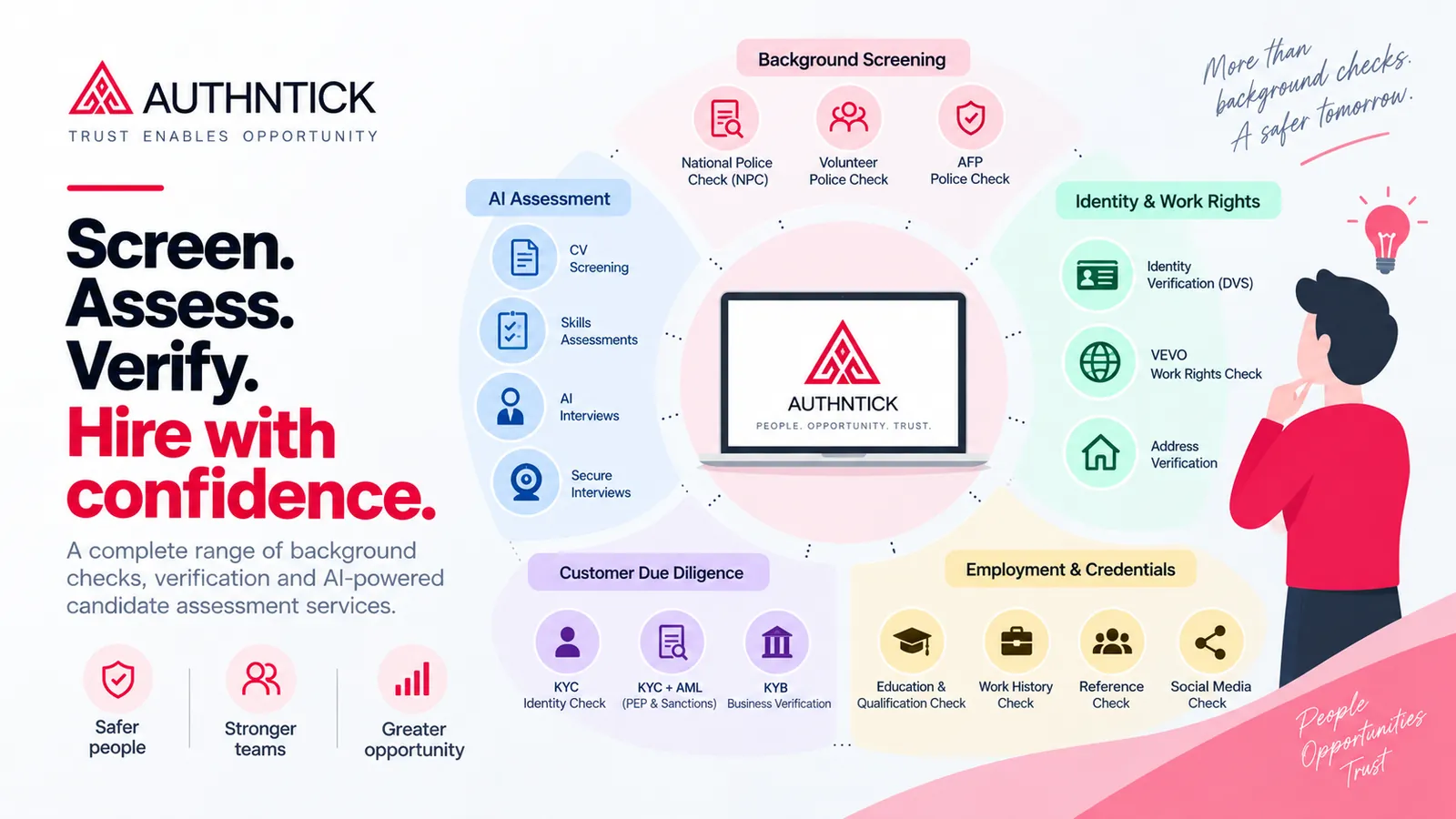
AuthNTick can help you complete structured reference checks, work history checks, identity checks, Nationally Coordinated Criminal History Checks and broader workforce screening services.
What is a professional reference check?
A professional reference check is a workforce screening process where a nominated referee is contacted to verify information about a candidate's previous role, responsibilities, performance, reliability, conduct and suitability for a position.
A referee may be a:
- direct manager, supervisor or team leader
- HR representative or business owner
- senior colleague
- authorised employer representative
The purpose of the check is not simply to ask whether the referee liked the candidate. A proper reference check should be structured, relevant to the role, supported by candidate consent, and recorded clearly in a report.
Why are reference checks important?
Reference checks help employers look beyond the resume. A candidate may perform well in an interview, but the employer may still need to understand whether the candidate's declared employment history is accurate, whether they performed the role described, and whether they were reliable and professional.
Reference checks can also help identify:
- role-related conduct or safety concerns
- suitability for positions involving trust, responsibility or sensitive information
- whether a previous manager or employer would re-engage the candidate
- discrepancies between candidate declarations and referee responses
How reference checks support AS 4811:2022 workforce screening
AS 4811:2022 Workforce Screening provides a framework for organisations to develop workforce screening principles, policies and processes. The standard encourages organisations to think about screening in a structured and risk-based way.
For reference checks, this means the process should consider:
- the role being assessed and the risk level of the position
- the candidate's consent
- the credibility of the referee and how the referee was verified
- whether the information collected is relevant to the role
- whether discrepancies or adverse information have been recorded clearly
- whether the final report is clear and auditable
Who needs a professional reference check?
Professional reference checks are useful for many types of organisations, including:
- employers hiring new staff
- recruitment agencies and labour hire providers
- government contractors and defence industry suppliers
- healthcare, disability, aged care and education providers
- transport, logistics, financial services and security-sensitive organisations
- charities, not-for-profits, contractors and volunteer programs
Reference checks are particularly useful where the role involves trust, access, safety, vulnerable people, money, confidential information, critical systems or client-facing responsibility.
What should a proper reference check include?
Candidate consent
The candidate should authorise the referee to be contacted for workforce screening purposes before the check begins.
Referee details
The report should record the referee's name, role, organisation, contact details, relationship to the candidate, and whether they directly managed or supervised the candidate.
Candidate role details
The candidate's title, dates, employment type, organisation and location should be captured so responses can be compared against the declaration.
Referee verification
Verification may consider business email domains, company websites, switchboards, LinkedIn profiles, HR confirmation, ABN details or the referee's role.
Employment confirmation
The referee should confirm role title, dates, employment type, duties and whether the candidate reported to them.
Performance and conduct
Questions should cover reliability, attendance, quality of work, professionalism, communication, policy compliance and role-relevant conduct.
Adverse or risk-relevant information
A proper reference check should include questions about substantiated, role-relevant concerns. This may include confirmed issues involving misconduct, dishonesty, fraud, bullying or harassment, workplace violence, safety breaches, serious policy breaches, confidentiality concerns or unexplained role-related concerns.
It is important that the report separates confirmed facts from opinions or unsubstantiated comments.
Re-employment and suitability
The referee should be asked clear final questions, such as:
- Would you re-employ or re-engage this person?
- Are there any role-related concerns the employer should consider?
- Is there anything else relevant to the candidate's suitability for the role?
This gives the employer a clearer final indication of the referee's view.
How many referees should be checked?
For a basic reference check, one completed referee may be sufficient. For a more complete employment screening process, two referees are often preferable. For higher-risk roles, organisations may request two completed references and allow a third referee as a backup.
In AuthNTick, organisation packages can require one, two or three referees. The standard unconfigured workflow allows up to two. The candidate follows the count configured for their check. These are configuration options, not separate Basic or Comprehensive product tiers or a guarantee that every referee will respond.
Reference Check vs Work History Verification
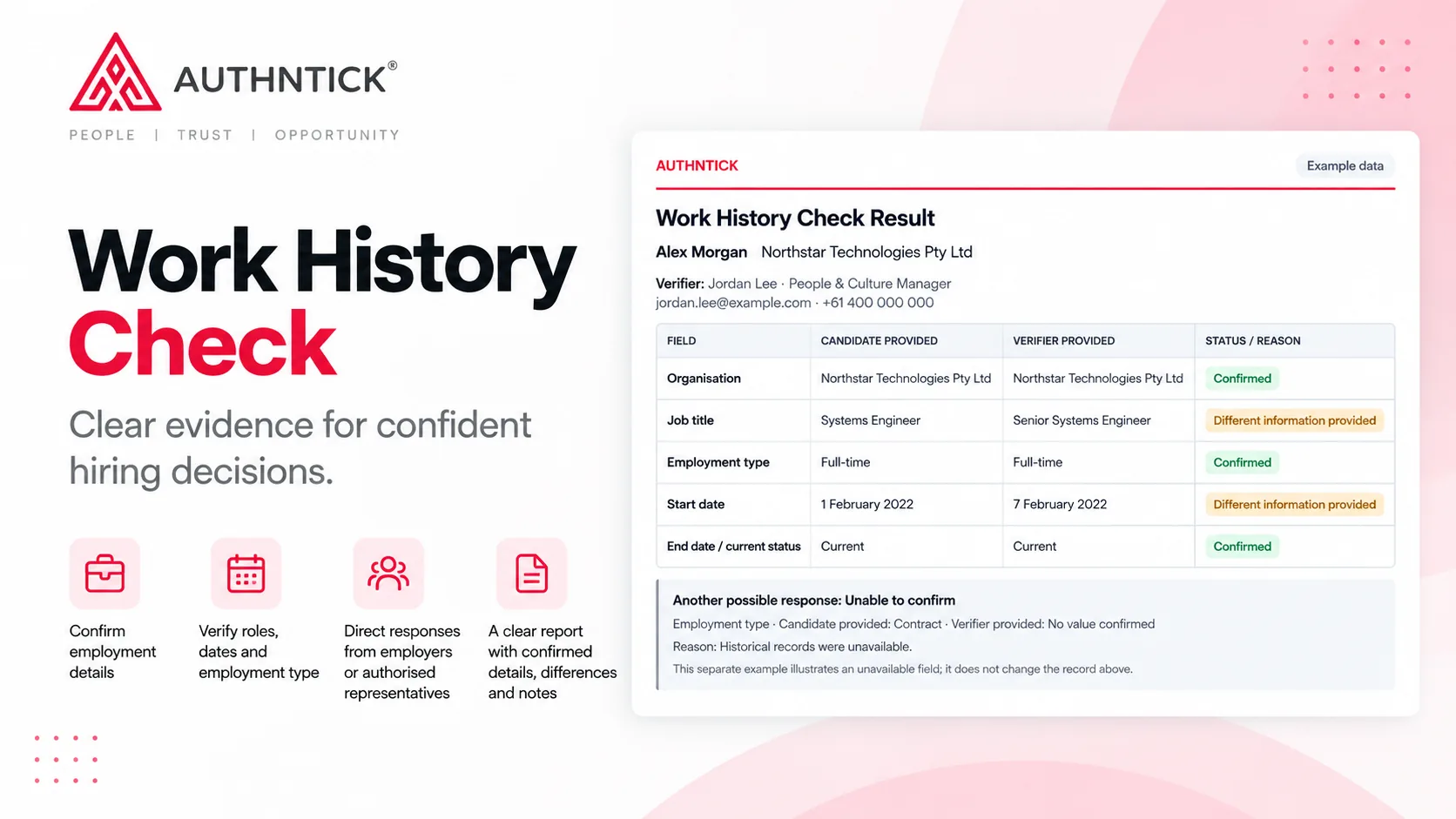
A Work History Check usually verifies employment facts, such as employer name, job title, employment dates, employment type and whether the candidate worked there.
A Reference Check goes further and may assess performance, conduct, reliability, professionalism, workplace behaviour, suitability for the role, and whether the referee would rehire the person.
For a stronger screening process, many organisations use both.
What should a reference check report include?
A professional reference check report should be clear, structured and easy for the employer to review. Candidate details and consent provide the foundation, while the following reporting layers help the employer distinguish review notes, referee information, qualitative feedback and decision guidance.
Reference review status
The report should provide a clear overall status showing whether confirmation issues, discrepancies, adverse information or limitations require customer review. Reference Review Notes should record the information supporting that status. The status is not an employment recommendation or a guarantee about the candidate.
Referee summary
A Referee Summary identifies the referee, their position and organisation, their relationship to the candidate, the candidate details supplied for comparison, response status and submission date. It is an overview of the referee and engagement, not a narrative summary of all qualitative feedback.
Reference summary
As a reporting principle, a concise Reference Summary may bring together the relationship and employment details confirmed by the referee, the candidate's role and responsibilities, performance, professionalism and conduct feedback, disclosed safety, integrity or reliability concerns, suitability and re-employment responses, and any differences or limitations requiring customer review.
Complete referee responses
Every original question and answer should remain available below any summary. The complete referee responses are the source record: a summary assists review but does not replace the referee's original answers.
Customer decision guidance
The report forms one part of a broader screening process. AuthNTick records and presents the information but does not make the final employment, engagement, licensing or suitability decision. Customers should apply their policies, the role's risks and the applicable screening terms.
How a reference summary helps employers review the result
A structured employment reference check can still contain detailed factual and qualitative responses. Employers may need to compare duties and employment details, interpret performance comments and conduct ratings, and consider suitability and re-employment answers. A concise reference summary can make the main information easier to understand and draw attention to matters requiring review.
A useful summary should be evidence-based and limited to information supplied in the reference. It should distinguish the referee's statements from independently verified facts, avoid inferring missing information and avoid making an automatic hiring recommendation. It supports, but does not replace, the employer's assessment or the complete question-and-answer record.
Illustrative report only. All names, companies, dates, contact details and performance comments are fictional.
Completed Reference Check report
A start date difference and a disclosed reliability concern require customer review.
Employment confirmation
Difference recorded for customer review. Ask for context before drawing a conclusion.
Complete referee responses · excerpt
- Overall performance rating
- Good
- Performance comments
- Jordan coordinated a quarterly access review and explained the follow-up actions clearly to the service owners.
- Conduct/professionalism rating
- Good
- Any known conduct, integrity, safety, or reliability concerns?
- Yes
- Concern details
- During one access review, Jordan missed an internal handover deadline. We discussed it and introduced a shared checklist.
- Suitable for the role/purpose of screening?
- Yes
- Would you re-employ/re-engage?
- Yes
Evidence for your decision — not the decision itself. All names, dates and responses are fictional. Actual sections depend on the selected questionnaire.
What happens when more than one referee responds?
As a matter of good reporting practice, each referee's answers should remain separately identifiable. A consolidated overview may help an employer identify:
- employment details confirmed consistently
- recurring strengths, observations or different perspectives
- differences in position titles, dates or responsibilities
- conflicting suitability or re-employment responses
- concerns disclosed by only one referee
- incomplete or unanswered information
Any differences should be shown clearly for customer review rather than automatically resolved by the platform. The individual referee responses should remain available as the source records.
Understanding reference review status
The completed report records confirmation issues, discrepancies, disclosed concerns and limitations for customer review. A submitted response and a favourable employment decision are different things. If an invitation expires without a response, the report can record an unverified referee and the associated limitation.
Read the review notes and each referee's original answers. A difference in dates is something to clarify, not an automatic finding of dishonesty; an unanswered question is not proof that no concerns exist.
Common risks in poor reference checks
- relying only on candidate-supplied personal email addresses
- not verifying the referee's connection to the employer
- asking inconsistent or irrelevant questions
- failing to capture consent
- asking discriminatory questions
- treating opinion as verified fact
- not recording discrepancies or limitations
- not keeping an audit trail
A reference check should be fair, relevant, consistent and properly documented.
Why choose AuthNTick for reference checks?
Support for a risk-based screening process
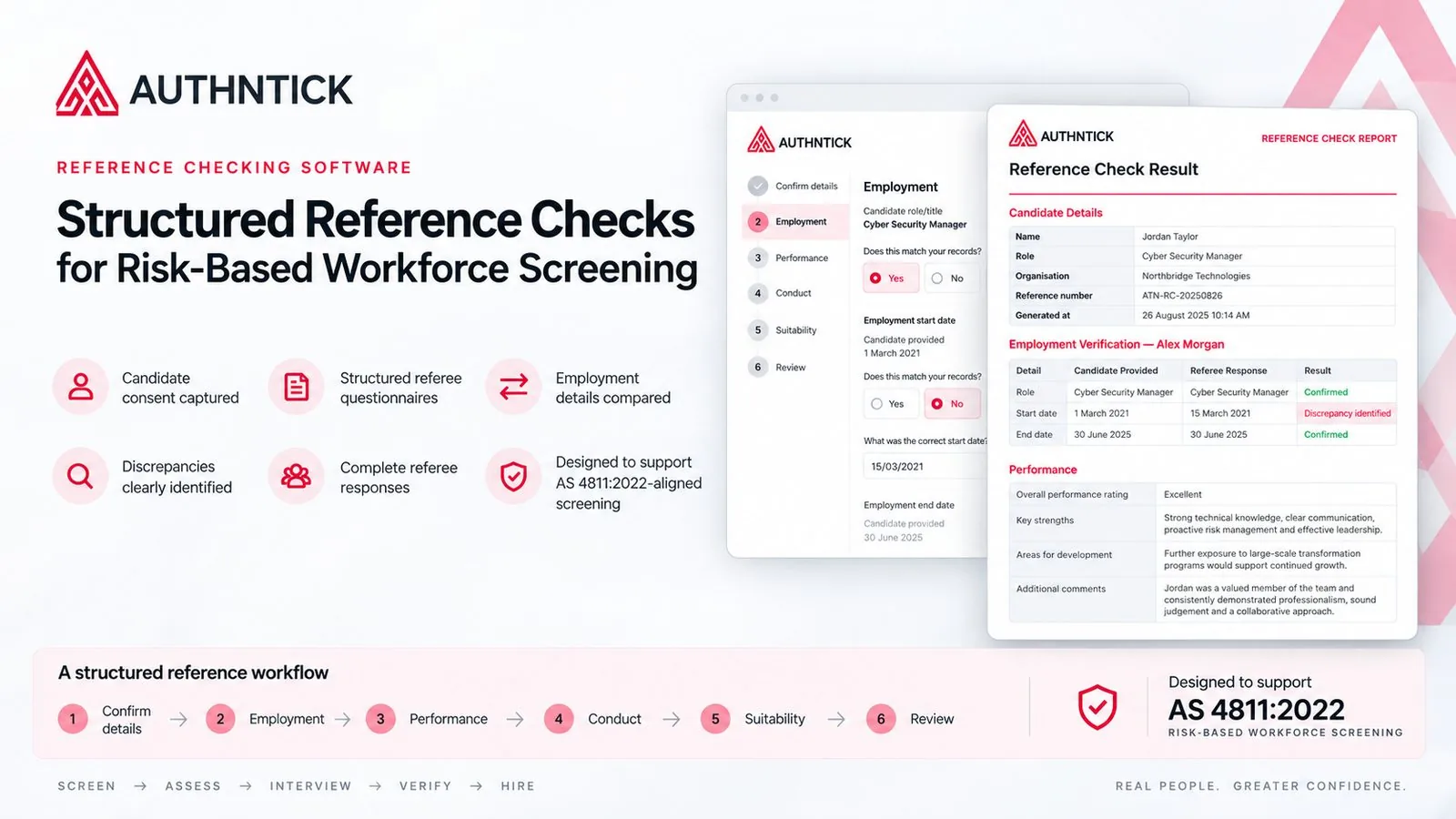
Designed to support AS 4811:2022-aligned, risk-based workforce screening. Candidate consent precedes the invitation; Confirm details records the relationship; Employment captures confirmations and differences; Performance, Conduct and Suitability collect relevant evidence; Review lets the referee check their answers before submission.
Consent built into the workflow
Candidates provide consent before referees are contacted, supporting a transparent workforce screening process.
Referee relationship information
AuthNTick captures referee contact, organisation and relationship details so employers can assess reference strength.
Structured questions
Hiring teams can generate a role-specific questionnaire using AI, start from a pre-built template, customise questions or create their own questionnaire. Teams review the questions before selecting the template for an organisation package.
Clear, structured reports
AuthNTick reports organise candidate consent, referee details, employment confirmation, performance and conduct responses, suitability information, review notes and limitations in a clear format. Complete referee responses remain available so employers can review the information supporting the reported outcome.
Practical for different risk levels
AuthNTick can support basic reference checks or broader packages with Nationally Coordinated Criminal History Checks, AFP Police Checks, VEVO Checks, work history checks, identity verification and address checks.
Start with the role and the questions that matter
A cyber security manager and a customer service supervisor need different questions. Hiring teams can prepare a questionnaire in three ways:
- Generate with AI: enter the industry, role and reference type, select relevant competencies and optionally add a job description to generate a draft questionnaire.
- Start from a pre-built template: choose from the reference questionnaire library and customise a copy for your organisation.
- Create your own: start with a blank questionnaire and add the sections and questions you need.
Review the wording, response options and required questions before using a template. AI-generated questions are a starting point for customer review; they do not establish that the questionnaire is accurate, appropriate or sufficient for a particular role.
Select the questionnaire and required referee count when configuring an organisation package. Packages support one, two or three required referees. The standard unconfigured workflow allows up to two; the candidate follows the configuration of their check.
Candidate consent, then a digital invitation
The candidate supplies referee contact and relationship details, relevant employment information and consent to contact their nominees. Nominated referees receive a digital invitation to respond. The relationship confirmation gives the referee a chance to identify an incorrect relationship or say that they cannot provide the reference.
A nominated contact is not automatically an independent or credible source. Consider whether the referee observed the relevant work, and investigate identity or relationship concerns where needed. AuthNTick captures the information supplied; it does not independently guarantee every statement.
Six stages from confirmation to review
The standard employment questionnaire follows Confirm details → Employment → Performance → Conduct → Suitability → Review. The selected template determines the questions and sections, so custom questionnaires may differ.
Illustrative example only: all names, companies, dates, email addresses and responses in the previews are fictional.
Step 1 of 6 · Confirm details
Confirm details
Do you confirm the relationship shown above?
Can you provide this reference?
Explore the stages above. This example does not submit a reference. All names, dates and responses are fictional. Actual sections depend on the selected questionnaire.
- Confirm details: review the candidate and relationship information and confirm whether the referee can provide a reference.
- Employment: confirm the candidate-provided role and dates or supply corrections where information differs.
- Performance: describe responsibilities, strengths, development areas and observed performance.
- Conduct: provide professionalism and reliability feedback and disclose relevant concerns or limits on what can be commented on.
- Suitability: answer the role-related suitability and re-employment questions from the referee's perspective.
- Review: check the answers and declaration before submitting.
The workflow saves progress and sends reminders for eligible pending requests. A referee can still decline or fail to respond. An expired invitation can be recorded as unverified with the relevant limitation; a request does not guarantee a completed response.
Candidate information, referee evidence and customer review
The candidate supplies their employment details, nominated contacts, relationship information and consent. The referee supplies confirmations, corrections and their own observations. AuthNTick review notes and status identify confirmation issues, differences, disclosed concerns and limitations. The customer assesses that evidence and makes the employment decision.
Both values remain visible when information differs. In the fictional report example above, Jordan Taylor declared a start date of 3 February 2020 and Alex Morgan supplied 17 February 2020. Neither value silently replaces the other. This is a difference for customer review, not evidence of dishonesty. Seek context and give the candidate an opportunity to explain material differences.
AuthNTick does not independently guarantee every referee statement. A referee may have limited knowledge, be unable to confirm dates, decline to comment or not respond. Record what cannot be verified; missing information does not establish that no concerns exist. Pending referee details can be updated before submission.
In the wider Screen → Assess → Interview → Verify → Hire journey, reference evidence complements CV Screening, Skills Assessments, Eilo AI Interviews, background screening and identity verification. Assess the evidence together in the context of the role.
Explore the Reference Check product and Reference Check screening terms for service scope and customer responsibilities.
When should an employer order a reference check?
Employers should consider ordering a professional reference check before making a final hiring or engagement decision, especially where the role involves:
- access to customers, clients or sensitive data
- access to money or financial systems
- safety-sensitive work or vulnerable people
- government or regulated environments
- remote work with limited supervision
- management responsibility
- security-sensitive duties
- contractor or supplier access
Frequently asked questions about reference checks
What is a professional reference check?
A professional reference check collects employment confirmations and role-relevant feedback from a nominated referee about a candidate’s responsibilities, performance, conduct and suitability. It provides evidence for the customer’s assessment.
How does online reference checking work with AuthNTick?
The hiring team selects a questionnaire and referee requirements. The candidate supplies nomination details and consent before referees receive digital invitations. The standard questionnaire follows Confirm details, Employment, Performance, Conduct, Suitability and Review. The completed report retains the original questions and answers.
Can we customise the reference check questions?
Yes. Generate a draft with AI, customise a pre-built template or create your own questionnaire. Review wording, response options and role relevance before selecting the template for an organisation package. Custom questionnaires may have different sections from the standard six-stage experience.
How many referees can be requested?
Organisation packages can require one, two or three referees. The standard unconfigured workflow allows up to two. Each referee’s answers remain separately identifiable; requesting a reference does not guarantee a response.
What if a referee disagrees with the candidate or does not respond?
Candidate-supplied and referee-supplied values are shown for customer review. A difference is not itself evidence of dishonesty. Eligible pending requests receive reminders; an expired invitation can be recorded as unverified with the relevant limitation. Customers should seek context where needed.
What does a Reference Check report contain?
The report organises candidate details and consent, referee details, employment confirmations and differences, performance and conduct responses, suitability and re-employment answers, review status and notes, limitations and the complete question-and-answer record. Referee statements are distinct from AuthNTick review information and the customer’s decision.
How is a Reference Check different from Work History Verification?
Work History Verification focuses on factual employment claims such as employer, position and dates. A Reference Check also gathers the nominated referee’s qualitative observations about performance, conduct and suitability.
Does AuthNTick decide whether to hire the candidate or certify AS 4811:2022 compliance?
No. AuthNTick provides evidence for the customer’s decision and does not independently guarantee every referee statement. Reference Checks are designed to support an organisation’s AS 4811:2022-aligned workforce screening process. An individual check does not establish or certify compliance.
Final thoughts
A professional reference check is more than a hiring formality. It is a practical workforce screening tool that helps employers understand whether a candidate's declared history, conduct and suitability align with the role.
When completed properly, reference checks help organisations reduce hiring risk, improve screening consistency and create a clearer audit trail.
Need to verify a candidate's professional references?
AuthNTick can help you complete structured reference checks, work history checks, identity checks, Nationally Coordinated Criminal History Checks and broader workforce screening services. Organisations can also explore the business screening dashboard.

About the author
Rahul Tripathi
Engineering and technology contributor
Rahul Tripathi is an engineer with interests in computer networks, digital systems and applied technology. At AuthNTick, he contributes to guides about digital identity, verification technology and practical screening workflows.
Editorial references
Official and authoritative sources
Use these primary and authoritative references to confirm current requirements for the topic covered in this guide.
- AS 4811:2022 Workforce screening Standards Australia
- Employment and privacy rights Office of the Australian Information Commissioner
- Guide to preventing discrimination in recruitment Australian Human Rights Commission
This guide is general information, not legal advice. Government processes and employer requirements can change, so check the linked source and the requesting organisation’s instructions before acting. Read our editorial and corrections policy.
Next step
Ready to move from research to action?
Use AuthNTick to complete secure Australian background checks, or speak with our team if you need the right workflow for your organisation.