Social media is now part of a person's public online presence. For some roles, organisations may need to understand whether publicly available or voluntarily provided information creates role-relevant concerns.
A Social Media / Online Presence Check should not be a casual search into a candidate's private life. It should be structured, consent-based, privacy-aware, role-relevant, evidence-based, and fair.
AuthNTick helps organisations conduct online presence screening through a controlled process focused on publicly available or voluntarily provided information, clear limitations, and role-relevant findings.
Need a structured online presence check?
AuthNTick Identity Services can help your organisation conduct Social Media / Online Presence Checks using a privacy-aware, role-relevant process.
What is a social media background check?
A social media background check reviews publicly available or voluntarily provided online information. This may include public profiles, usernames, posts, comments, videos, images, professional profiles, webpages, blogs, and other open-source online material.
The purpose is not to judge a person's private life. The purpose is to identify role-relevant concerns that may matter for a specific position, risk profile, or workforce screening requirement.
How does an AuthNTick Social Media Check work?
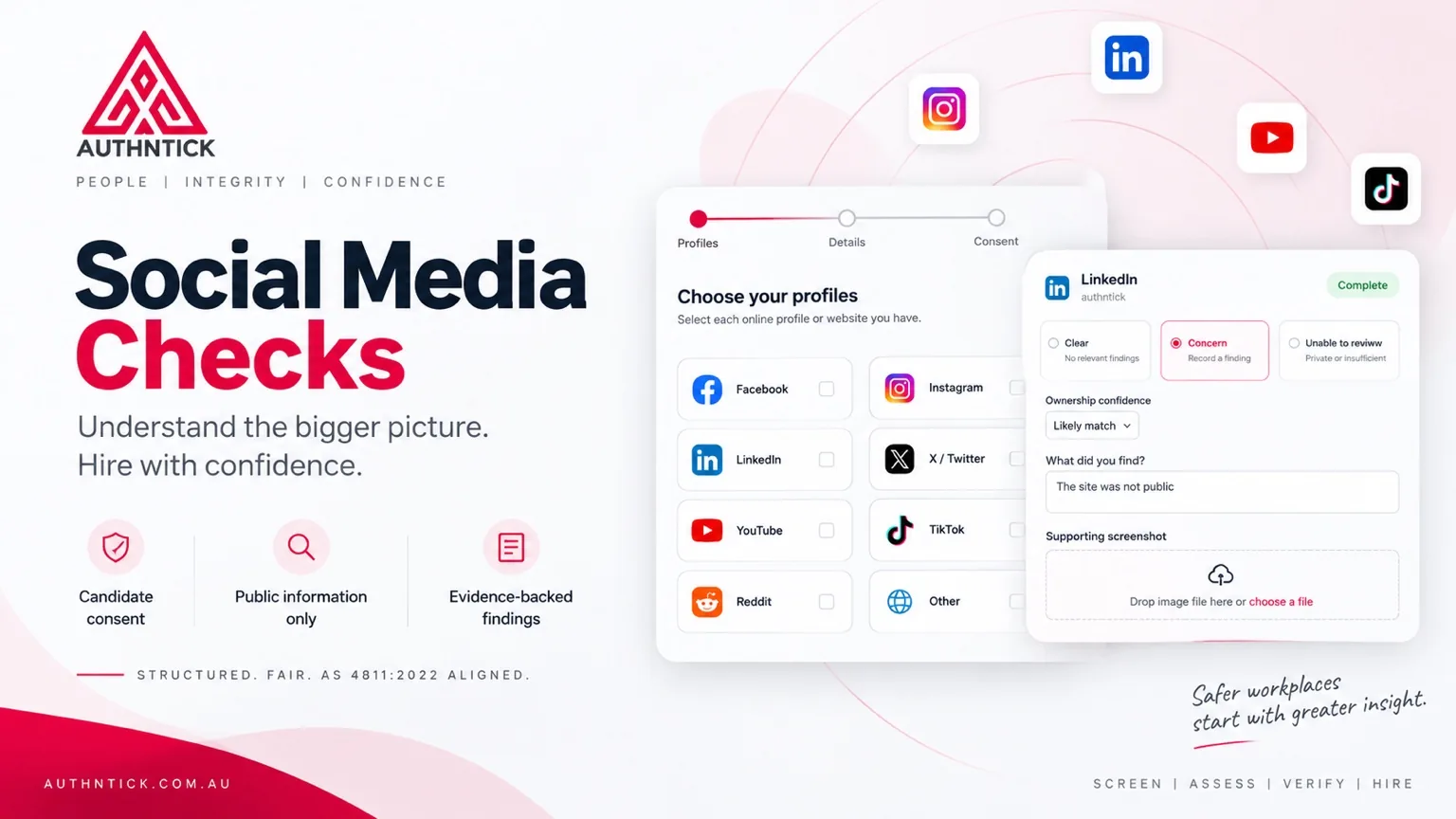
AuthNTick’s candidate social media check starts with the person being screened: select profiles, add details, review the information and provide consent. The reviewer then assesses each supplied account within the agreed scope.
1. Profile selection
The candidate identifies the online profiles they use. Supported profiles can include Facebook, Instagram, LinkedIn, X / Twitter, TikTok, YouTube, Reddit, Snapchat, Threads, GitHub, personal websites or blogs, and other online profiles. Availability and the agreed scope determine which sources can be reviewed.
2. Profile information
For each selected account, the candidate provides the profile URL, display name, normal account visibility and confirmation of whether the account belongs to them. Visibility options are Public, Private, Partially public and Not sure. Alternate usernames or notes can provide context; notes are required for the Other profile option.
3. Consent
The candidate reviews the supplied profile information and provides consent before the check begins. The consent process explains that AuthNTick reviews publicly available information and information voluntarily provided by the candidate.
4. Public-source review
AuthNTick reviews accessible information within the scope of the check. We do not request account passwords, require private accounts to be made public, bypass privacy controls, use fake accounts, impersonate anyone or attempt to access private or restricted content. Candidate-provided information may be considered where lawful and relevant to the screening purpose.
5. Account-by-account assessment
Each supplied account is reviewed individually. Clear means no relevant findings were identified from the information reviewed. Concern means a potentially relevant finding is recorded for further review. Unable to review means the account is private, inaccessible or has insufficient public information. A private account is a review limitation, not automatically an adverse finding.
6. Ownership confidence
Where appropriate, the reviewer records confidence that the identified account belongs to the candidate, such as Likely match. Candidate-supplied URLs, display names, usernames, ownership confirmation and contextual profile information help reduce misattribution. A name alone is not enough: similar names, incomplete or old profiles, parody accounts, impersonation and ambiguous identifiers can create uncertainty. Ownership confidence does not guarantee identity.
7. Evidence-backed findings
If potentially relevant information is identified, the reviewer records the finding and supporting evidence. Platform details, ownership confidence, the finding summary, screenshots or other evidence and relevant reviewer notes preserve context for authorised human review. The result is not an unexplained automated score.
8. Structured reporting
The completed check records relevant findings and limitations for authorised review by the requesting organisation. AuthNTick does not make the final employment decision. The organisation remains responsible for considering the information in context and making any employment or engagement decision.
What does AuthNTick review?
Depending on the information provided by the candidate and the scope requested by the organisation, AuthNTick may review publicly available or voluntarily provided information from:
- X / Twitter
- TikTok
- YouTube
- Snapchat
- Threads
- GitHub
- personal websites and blogs
- other public online profiles
Candidates may be asked to provide profile links, usernames, handles, display names, other online aliases, account visibility details, consent, and a declaration that the information provided is true and complete.
What AuthNTick does not do
Privacy boundaries matter. AuthNTick does not:
- request passwords
- ask candidates to make private accounts public
- access private messages
- bypass privacy settings
- use fake accounts
- impersonate another person
- attempt to access private or restricted content
- treat a private account as an adverse finding by itself
What information may be identified?
A social media check may identify publicly available or voluntarily provided information that appears relevant to the role or screening purpose. Examples can include:
- threats, violence, harassment, or intimidation
- discriminatory abuse
- fraud, scams, or impersonation
- serious professional misconduct
- child-safety or vulnerable-person risk
- disclosure of confidential information
- extremist or violent content
- conduct creating role-relevant safety, integrity, or reputational risk
AuthNTick does not make final employment decisions. The requesting organisation remains responsible for reviewing any information in context and applying its own policies, legal obligations, and decision-making process.
Why employers use social media checks
Social media checks may be considered where a role involves public trust, vulnerable people, children, security-sensitive work, government or defence-related work, senior leadership, public-facing duties, confidential information, or brand and reputational risk.
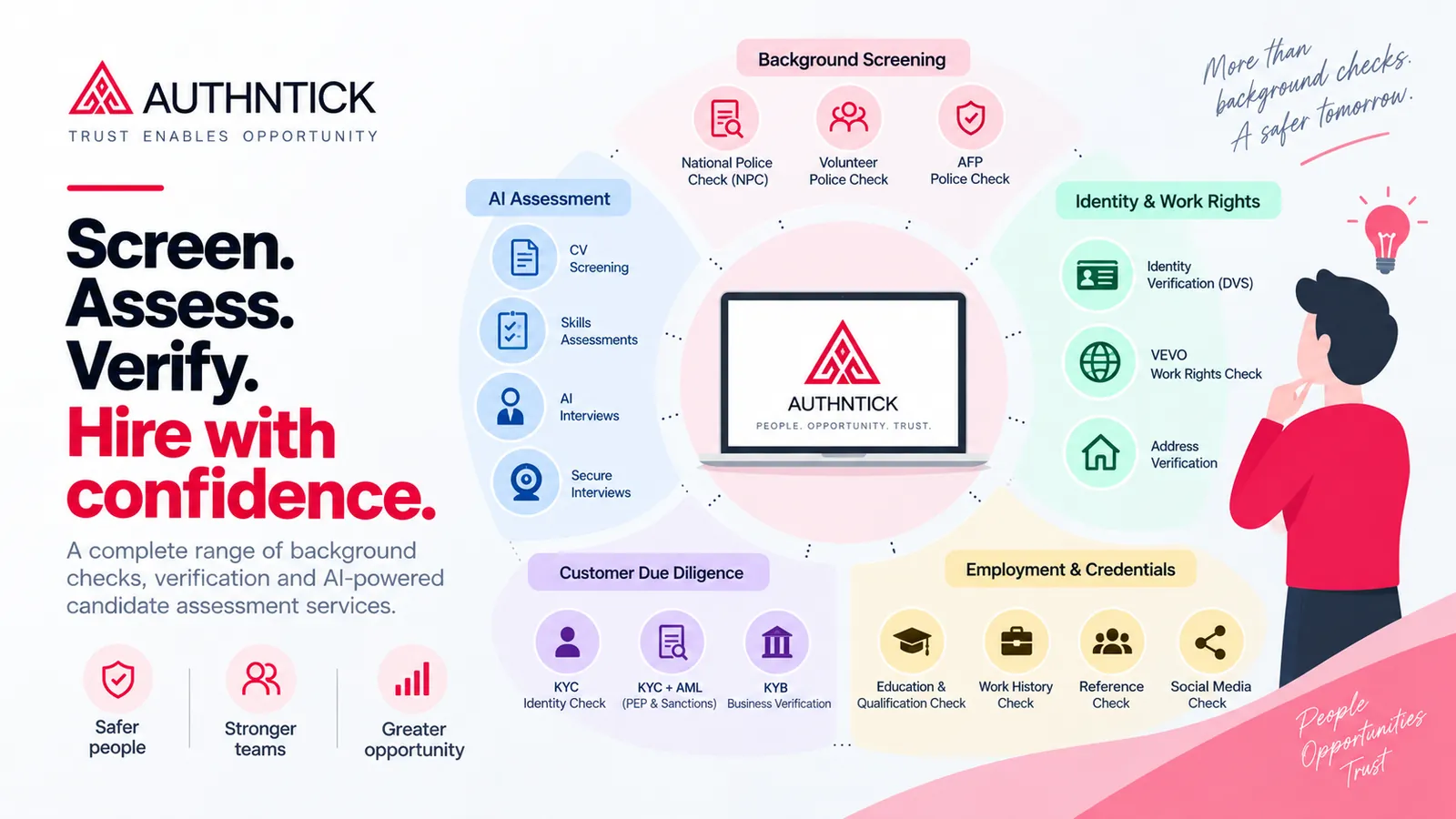
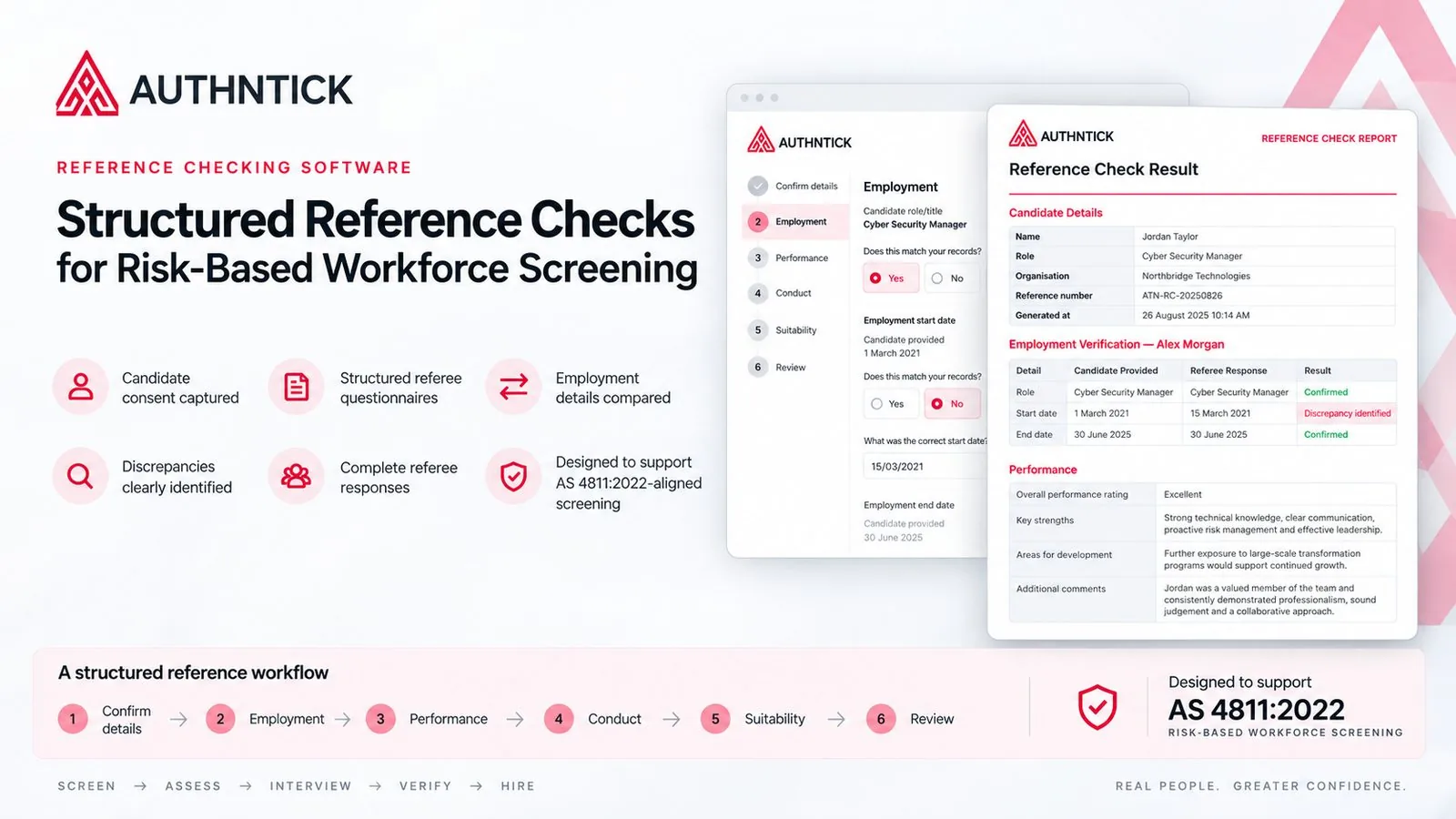
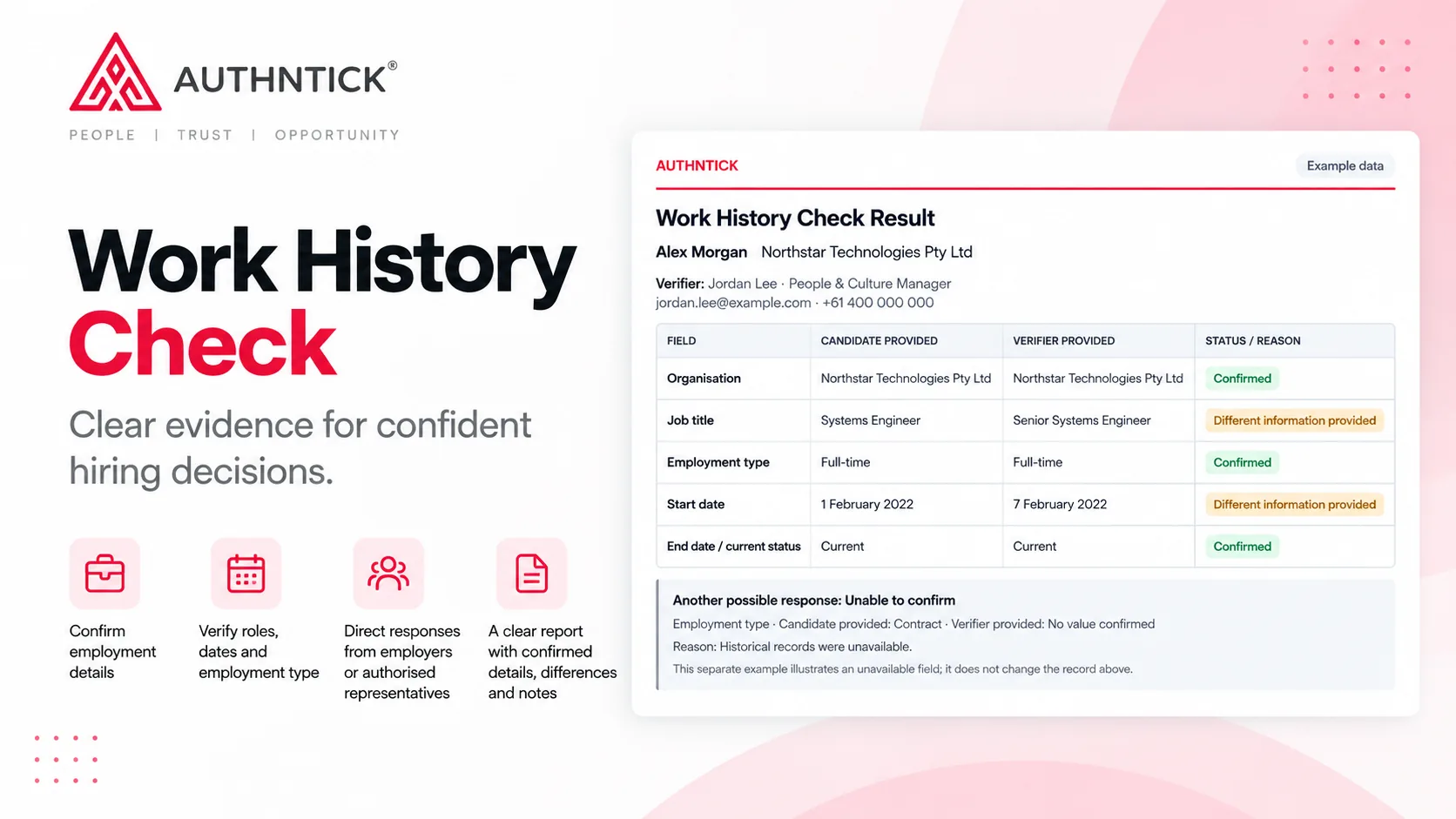
They may also sit alongside other checks such as a Nationally Coordinated Criminal History Check, AFP Police Check, VEVO Check, Work History Check, or Reference Check.
Why a controlled process matters
Informal searches by hiring managers can create privacy, fairness, consistency, and discrimination risks. A controlled process helps keep the review focused on consent, public information, role-relevant findings, clear limitations, evidence-based assessment, and candidate clarification where required.
This helps avoid relying on outdated, fake, hacked, wrongly attributed, or out-of-context content.
Candidate privacy and fairness
AuthNTick does not access private content, request passwords, or require private accounts to be made public. Where information is unclear or potentially adverse, candidates may be asked to clarify ownership, context, or accuracy before the matter is finalised.
Protected attributes, political or religious beliefs and lawful personal opinions are not by themselves adverse findings. A fair process recognises that online content can be incomplete, misattributed, outdated, impersonated, hacked, or taken out of context.
Read the Screening Services Terms and Privacy Policy for the scope and handling of screening information.
Account decisions and the overall check outcome
The reviewer’s account-level decisions are Clear, Concern and Unable to review. These describe individual accounts, not a hiring recommendation.
The result certificate combines account findings, clarification needs and review limitations into an overall check outcome:
- Relevant Finding Identified
- A potentially relevant finding has been recorded and requires consideration in context.
- Clarification Required
- Candidate clarification is required, with no relevant finding taking priority in the overall result.
- Unable to Verify
- Review limitations remain, with no relevant finding or clarification requirement taking priority. This does not by itself indicate adverse conduct.
- No Relevant Public Findings Identified
- At least one account was assessed and no relevant findings, clarification requirements or inability-to-review outcomes were recorded.
- Not Assessed
- No supplied account was assessed.
Read the account details and limitations alongside the overall result. The platform’s Result Ready workflow status means the result is available; it does not mean a candidate has been approved for employment.
What candidates may need to provide
- profile links
- usernames or handles
- display names
- whether accounts are public, private, partially public, or not sure
- other online names or aliases
- confirmation that the accounts belong to them
- consent
- a declaration that information is true and complete
What employers receive
Clear checks usually provide a summary result, not unnecessary screenshots. Where a role-relevant concern is identified, the report may include a finding summary, platform, date reviewed, relevance, and limited supporting evidence where necessary.
Evidence may be retained for audit, quality assurance, and dispute handling in accordance with applicable policies and privacy requirements.
Social media checks and AS 4811:2022
AS 4811:2022 is a workforce screening standard, not a specific social media check standard. A social media check may form part of a broader role-risk-based workforce screening process where justified.
A Social Media / Online Presence Check can support an AS 4811:2022-aligned workforce screening process where role-risk justified. AS 4811:2022 does not require a social media check for every worker or role. AuthNTick’s structured, consent-based and evidence-recorded process supports a risk-based framework where justified; this is not a certification claim.
When should an organisation request a social media check?
Organisations may consider social media checks for trust and integrity roles, sensitive information access, vulnerable people, child-related duties, government, defence or security-sensitive work, public representation, high reputational risk, and senior leadership.
The decision should be based on the role, risk profile, legal requirements, screening policy, and whether the review is proportionate.
Final thoughts
Social media checks should not be casual searches into a candidate's private life. They should be consent-based, privacy-aware, role-relevant, evidence-based, and fair.
A structured process helps employers avoid unnecessary privacy risk while giving candidates a clearer and more respectful screening experience.
Need a structured online presence check?
AuthNTick Identity Services can help your organisation conduct Social Media / Online Presence Checks using a privacy-aware, role-relevant process.
Frequently asked questions
What is a social media background check?
A social media background check reviews publicly available or voluntarily provided online information within an agreed screening scope. AuthNTick uses candidate-supplied profiles, consent, account-level review and documented findings relevant to the role.
What social media platforms can be reviewed?
Depending on candidate-provided details, availability and the agreed scope, sources may include Facebook, Instagram, LinkedIn, X / Twitter, TikTok, YouTube, Reddit, Snapchat, Threads, GitHub, personal websites or blogs and other public profiles. Not every source is available or reviewed for every check.
Does AuthNTick access private accounts?
No. AuthNTick does not access private accounts or messages, bypass privacy controls, use fake accounts or impersonate anyone. Information voluntarily provided by the candidate may be considered where lawful and relevant to the screening purpose.
Do candidates need to provide passwords?
No. AuthNTick does not request social media passwords.
Does a candidate have to make a private account public?
No. Candidates are not required to unlock private accounts or change their privacy settings.
What happens if an account is private?
An account may be recorded as Unable to review because it is private, inaccessible or has insufficient public information. This is a review limitation and is not automatically an adverse finding.
How does AuthNTick know a profile belongs to the candidate?
Candidate-supplied URLs, display names, usernames, ownership confirmation and contextual profile information help the reviewer assess ownership confidence. A Likely match is not a guarantee of identity; uncertain attribution must be considered in context.
What happens when a concern is identified?
The reviewer documents the potentially relevant finding and supporting evidence for authorised human review. Context and ownership confidence matter, and the candidate may be asked to clarify ownership, accuracy or context.
Does AuthNTick automatically decide whether to hire someone?
No. AuthNTick supplies screening information. The requesting organisation remains responsible for considering the information in context and making any employment or engagement decision.
Are social media checks required by AS 4811:2022?
No. AS 4811:2022 does not require a social media check for every worker or role. An online presence review may form part of a risk-based workforce screening framework where justified by the role. This is not a certification claim.
Can a social media check find everything online?
No. It is a point-in-time review of available information within the agreed scope. Private, deleted, inaccessible or unidentified material may limit the review.
Is every controversial post relevant to employment?
No. Protected attributes, political or religious beliefs and lawful personal opinions are not by themselves adverse findings. Review must focus on the screening purpose, role relevance and context.
Is a social media check the same as a Nationally Coordinated Criminal History Check?
No. A social media check reviews public online presence. A Nationally Coordinated Criminal History Check searches relevant criminal history information for a stated purpose.
Who should use social media checks?
They may be appropriate for roles involving trust, vulnerable people, public representation, senior leadership, security-sensitive duties, or high reputational risk.

About the author
Rahul Tripathi
Engineering and technology contributor
Rahul Tripathi is an engineer with interests in computer networks, digital systems and applied technology. At AuthNTick, he contributes to guides about digital identity, verification technology and practical screening workflows.
Editorial references
Official and authoritative sources
Use these primary and authoritative references to confirm current requirements for the topic covered in this guide.
- AS 4811:2022 Workforce screening Standards Australia
- Employment and privacy rights Office of the Australian Information Commissioner
- Guide to preventing discrimination in recruitment Australian Human Rights Commission
This guide is general information, not legal advice. Government processes and employer requirements can change, so check the linked source and the requesting organisation’s instructions before acting. Read our editorial and corrections policy.
Next step
Ready to move from research to action?
Use AuthNTick to complete secure Australian background checks, or speak with our team if you need the right workflow for your organisation.