When Australians search for a Nationally Coordinated Criminal History Check, they often see references to ACIC accreditation, accredited bodies and the ACIC service. The short answer is that ACIC manages access to the national checking service, while individuals generally apply through an accredited body or an Australian police agency.
This guide explains what ACIC accreditation means, how a Nationally Coordinated Criminal History Check works and what individuals and organisations should review when choosing a provider. It also explains where AuthNTick fits.
What is the Australian Criminal Intelligence Commission?
The Australian Criminal Intelligence Commission, or ACIC, is an Australian Government agency. Among its functions, ACIC works with Australian police agencies and accredited bodies to deliver the ACIC service.
The ACIC service enables people to apply for a Nationally Coordinated Criminal History Check. ACIC manages the national support system used to lodge and process applications, controls accredited access to the service and sets contractual requirements for accredited bodies. Australian police agencies participate in searching, matching, assessing and releasing relevant police information under the applicable rules.
ACIC is not the provider that most candidates deal with during an ordinary online application. It does not accept applications or submit checks on behalf of individuals. AuthNTick is also not part of ACIC and is not a government agency.
What is ACIC accreditation?
ACIC accreditation authorises an eligible Australian organisation to access the National ACIC service and submit Nationally Coordinated Criminal History Checks on behalf of consenting candidates within its approved scope.
Before access is granted, an organisation is assessed for suitability and enters a legally binding agreement governing controlled access to the service. Applicable obligations include informed consent, identity verification, correct purpose and category information, privacy, information security, appropriate use and disclosure of results, staff practices, record handling, audit and operational compliance.
Accreditation is specific. It shows that the organisation has authorised access to the national service and must meet the requirements governing that access. It should not be described as ACIC endorsing every price, user-interface choice, integration, support claim or other commercial feature offered by that provider.
What is an ACIC-accredited body?
Direct definition
An ACIC-accredited body is an Australian organisation authorised to submit eligible Nationally Coordinated Criminal History Check applications through the ACIC service on behalf of consenting candidates.
ACIC’s framework includes commercial and non-commercial accredited bodies. Their permitted candidates, customers and check categories can differ according to their operational function and accreditation arrangements. A commercial accredited body may provide checks to individuals and approved customer organisations within the applicable rules. A non-commercial body is generally limited to its own personnel and certain authorised regulatory or administrative functions.
Accredited access also carries responsibility. Police and identity information is sensitive, and providers must protect it, restrict access and use it only for authorised purposes.
Can individuals apply directly to ACIC?
No. ACIC does not accept applications or submit checks on behalf of individuals. Its current public guidance says an individual can obtain a Nationally Coordinated Criminal History Check by applying through:
- an ACIC-accredited body that offers the required check;
- an Australian police agency that accepts applications for that purpose; or
- an appropriate authorised or statutory pathway where a specialised screening, licensing or regulatory process applies.
The final option matters because an ordinary Nationally Coordinated Criminal History Check is not interchangeable with every screening clearance. Working with Children Checks, NDIS Worker Screening Checks, some licences and other statutory schemes have their own authorised pathways.
What is a Nationally Coordinated Criminal History Check?
A Nationally Coordinated Criminal History Check (NCCHC) is the official check delivered through the ACIC service. It is a point-in-time result based on identifying information, Australian police information and the applicable release rules for the stated purpose.
Providers should use the official names Nationally Coordinated Criminal History Check and Nationally Coordinated Criminal History Volunteer Check clearly. They should also distinguish these products from an AFP Police Check, a Working with Children Check or other purpose-specific screening.
The appropriate check depends on why it is required. A Nationally Coordinated Criminal History Check must carry an accurate employment, licensing or entitlement purpose. An eligible Nationally Coordinated Criminal History Volunteer Check is for unpaid volunteer activity and should not be used for paid work.
How the ACIC service works
The service coordinates a name-based national checking process involving the candidate, the accredited body or police agency, ACIC systems and Australian police agencies. It is not merely a lookup in one provider-owned database.
- The candidate provides details and informed consent. The application identifies the person, the check category and the specific purpose for which the result is required.
- Identity is verified. Required identity documents and any name-linkage evidence are checked through the provider’s approved workflow.
- The accredited body submits the application. Eligible application data is lodged in the ACIC service Support System.
- The national service coordinates the search. Candidate details are compared with police information across participating Australian jurisdictions.
- Potential matches may be reviewed. Some applications clear quickly; others require manual matching, record collection or assessment by one or more police agencies.
- Police information is assessed for release. The purpose, check category, spent-conviction legislation and information-release policies affect what may be disclosed.
- The result returns through the submitting body. The accredited body or police agency provides the result through its approved delivery process.
The requesting organisation remains responsible for deciding what the result means for employment, licensing, access or suitability. Accreditation does not transfer that decision to ACIC or the provider.
Do all accredited providers access the same system?
Yes, accredited bodies submit eligible checks through the ACIC service. ACIC states that accredited bodies have equal access to the system; one provider does not maintain a separate, superior national criminal-history database or receive preferential police searching.
That does not mean every application can be described as producing an identical result in every circumstance. Outcomes depend on accurate identifying information, the selected purpose and check category, applicable release policy, information available to police agencies and any manual matching or review requirements. Submitting a different purpose or incomplete details is not a like-for-like comparison.
Providers can legitimately differ in the parts of the service they control:
Candidate experience
Form design, guidance, accessibility, status updates and identity-verification workflow.
Support
Channels, operating hours, escalation practices and help with incomplete applications.
Organisation tools
Invitations, dashboards, permissions, reporting, bulk workflows and record management.
Broader screening
VEVO, identity, education, employment, reference, online-presence and other supported checks.
Integrations
Links, bulk upload and API options that may connect screening with HR or recruitment systems.
Result handling
How authorised users receive, access, retain and securely dispose of sensitive results.
Why ACIC accreditation matters
Accreditation matters because it establishes controlled, accountable access to the national checking service. An accredited body operates under requirements designed to protect candidates and the integrity of Nationally Coordinated Criminal History Check processing.
- Authorised access: eligible applications can be submitted through the National ACIC service within the body’s approved scope.
- Informed consent: the candidate must understand and agree to the check and relevant handling of their information.
- Identity requirements: the provider must establish and link the candidate’s identity using the required process.
- Privacy and security: personal and police information must be collected, accessed, stored, disclosed and disposed of appropriately.
- Purpose and result use: applications and results must relate to a valid purpose and cannot be treated as general, unrestricted information.
- Audit and compliance: accredited bodies are subject to contractual oversight, audit and consequences if obligations are not met.
These controls do not guarantee a completely error-free result, a particular suitability decision or instant turnaround. Nationally Coordinated Criminal History Check processing is partially manual, and some applications need further review.
How can I confirm whether a provider is accredited?
Check the official ACIC source, then match the provider’s legal or trading name. ACIC publishes an official directory of commercial and non-commercial accredited bodies.
- Open the ACIC directory rather than relying on a search snippet or provider comparison page.
- Search for the provider’s legal entity and any listed trading name.
- Confirm the provider offers the check category and customer pathway appropriate to your purpose.
- Review the provider’s privacy information, consent process and published service terms.
- If the name or offering is unclear, ask the provider for its legal accreditation details before supplying identity documents.
As at 14 July 2026, the ACIC directory lists DPI Consulting Pty Limited (trading as authntick identity services) among commercial accredited bodies. Because accreditation status can change, readers should verify the live directory rather than treating any dated article as the final authority.
How to choose an ACIC-accredited provider
Start with accreditation, then assess whether the provider’s workflow suits your purpose, privacy expectations and operational needs. Price alone does not describe the quality or suitability of the service.
| Consideration | What to review | Why it matters |
|---|---|---|
| Accreditation status | Current ACIC directory entry, legal name and permitted service pathway. | Confirms authorised access to the national service. |
| Privacy and security | Privacy policy, collection notice, access controls, hosting, retention and secure disposal. | Applications contain identity and police information. |
| Identity-verification process | Accepted documents, name-linkage guidance, accessibility and support for special circumstances. | Accurate identity linkage is essential to a valid application. |
| Customer support | Available channels, Australian operating context and help with referred or incomplete checks. | Clear support can resolve avoidable application issues. |
| Candidate experience | Mobile usability, plain-language instructions, consent, progress indicators and notifications. | A clear workflow reduces errors and confusion. |
| Employer dashboard | Invitations, user permissions, status tracking, reporting and audit records. | Organisations may need controlled oversight at scale. |
| Screening integrations | Static links, bulk workflows, API capability and technical scoping. | Integration can reduce duplicate entry and manual handling. |
| Result handling and retention | Who can access results, how long they remain available and how copies are disposed of. | Results should not be retained or shared without an authorised need. |
| Individual or organisation fit | Supported purposes, check categories, volumes and additional screening services. | The right provider depends on the candidate and operational use case. |
About AuthNTick
AuthNTick provides eligible Nationally Coordinated Criminal History Checks through its ACIC-accredited service, subject to applicable terms, informed consent, identity requirements, purpose requirements and service eligibility. Its current accreditation entry can be checked in ACIC’s official directory under DPI Consulting Pty Limited.
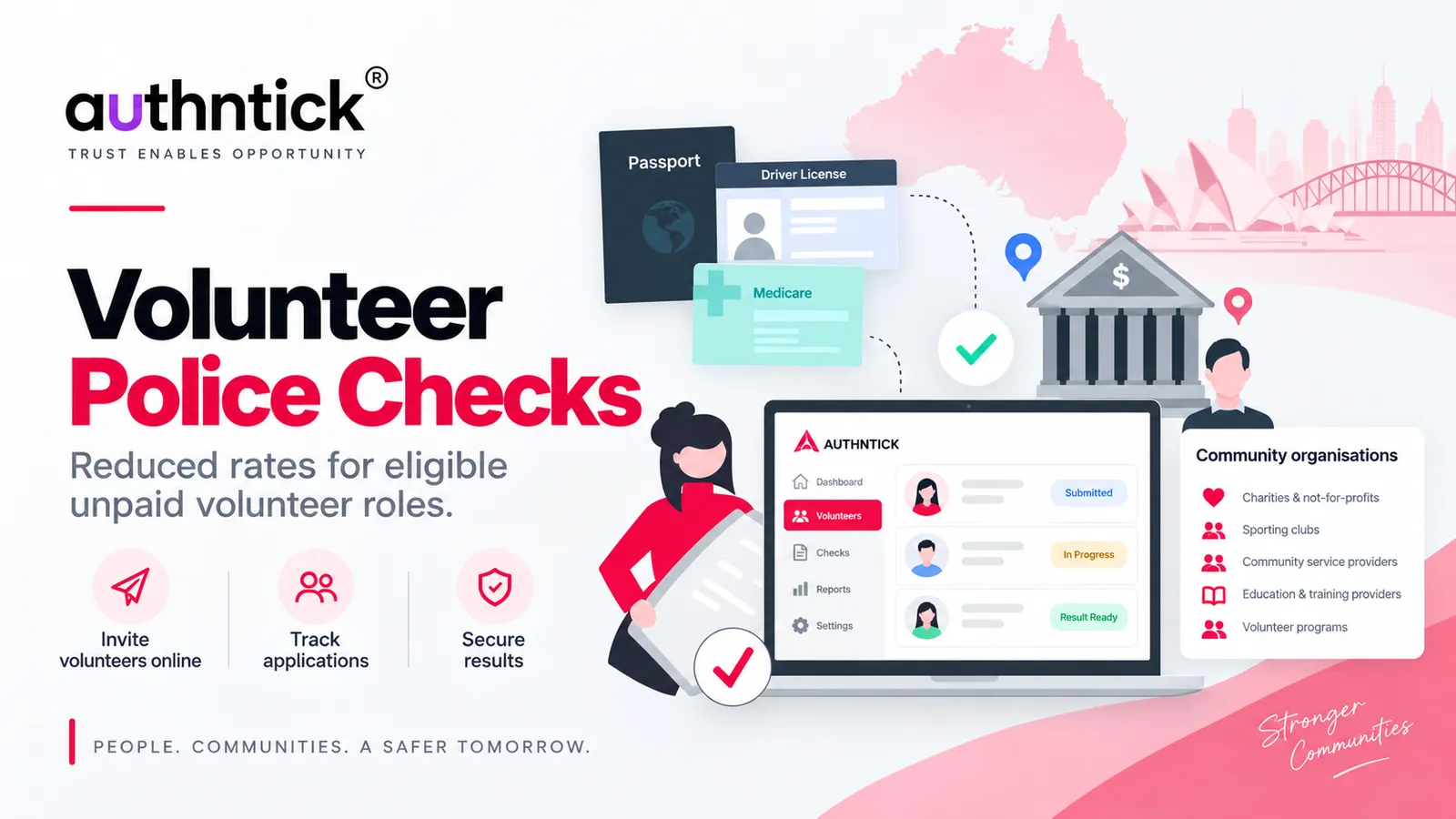
Individuals can use AuthNTick’s online workflow for eligible employment Nationally Coordinated Criminal History Checks and Nationally Coordinated Criminal History Volunteer Checks. The appropriate option depends on the intended purpose; an eligible volunteer category must not be used for paid employment.
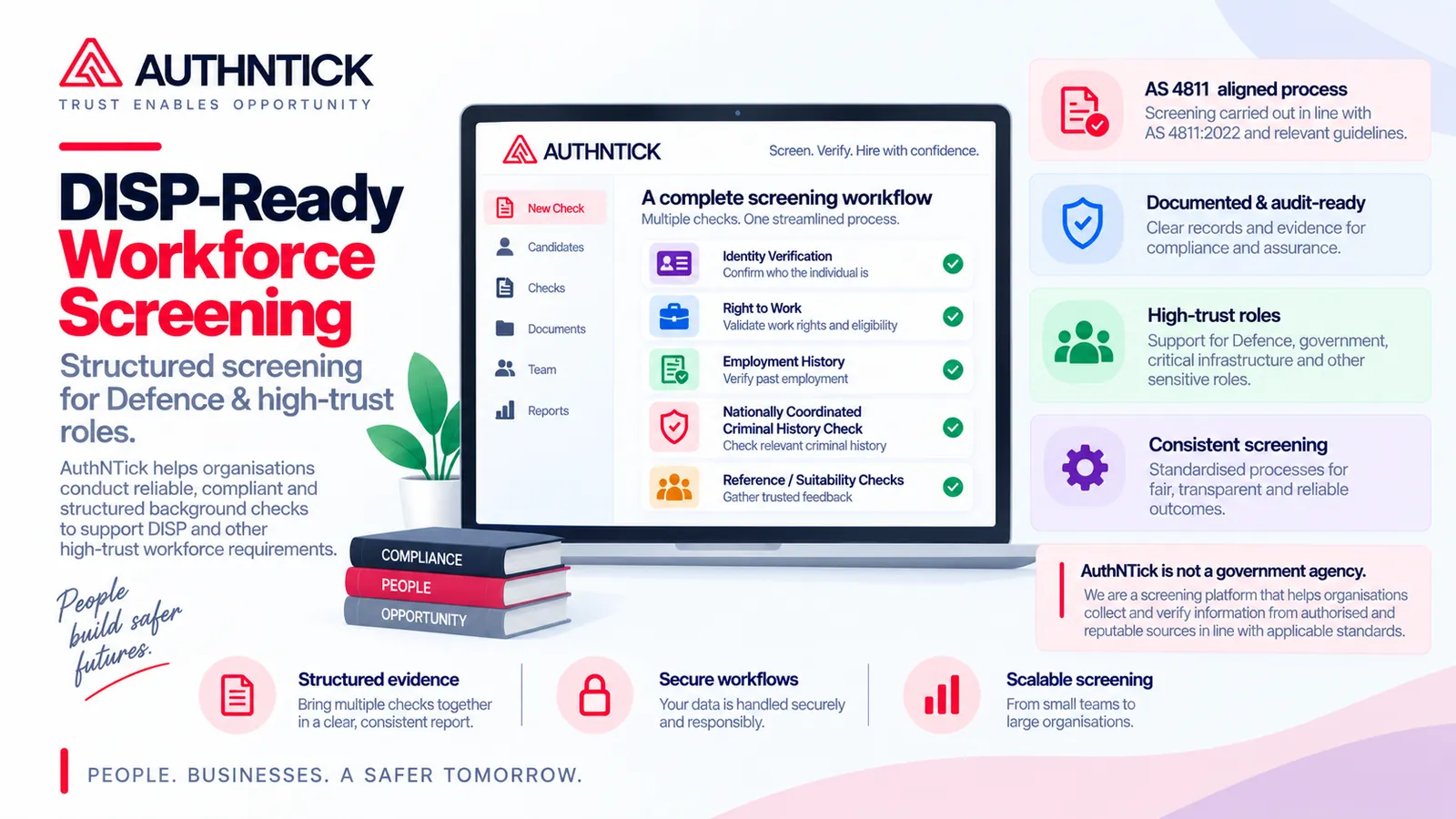
For organisations, the AuthNTick workforce screening platform supports candidate invitations, status tracking, authorised organisation access and broader screening workflows. Supported services include AFP Police Checks, VEVO work-right checks, DVS-informed identity verification, education and qualification checks, work-history verification, reference checks and social-media checks.
AuthNTick also publishes information about its privacy and data-handling approach and screening service terms. Australian-based support and API, invitation-link and bulk workflow options are available where applicable, subject to product availability, technical scoping, account configuration and agreement.
Common misconceptions about ACIC accreditation
Myth: Candidates apply directly to ACIC
Fact: ACIC does not accept individual applications. Applications generally go through an accredited body or Australian police agency.
Myth: Every online background-check business is accredited
Fact: Only appropriately accredited organisations can directly submit eligible checks through the ACIC service.
Myth: A provider controls what police information is released
Fact: Police information is assessed under the applicable checking process, purpose, legislation and release policy.
Myth: A delay means adverse history was found
Fact: Identity matching, older records, manual processing and agency workloads can cause delays without indicating an adverse result.
Myth: Accreditation guarantees the fastest result
Fact: Accredited bodies have equal access to the national system, and no provider can guarantee that police review will be instant.
Myth: One Nationally Coordinated Criminal History Check works for every purpose
Fact: Purpose and category matter. AFP, volunteer, employment and statutory screening pathways are not automatically interchangeable.
Frequently asked questions
What does ACIC stand for?
ACIC stands for the Australian Criminal Intelligence Commission, an Australian Government agency that works with Australian police agencies and accredited bodies to deliver the ACIC service.
What is an ACIC-accredited body?
An ACIC-accredited body is an Australian organisation authorised to submit eligible Nationally Coordinated Criminal History Check applications through the ACIC service on behalf of consenting candidates.
Can I apply directly to ACIC for a Nationally Coordinated Criminal History Check?
No. ACIC does not accept applications or submit checks for individuals. You generally apply through an ACIC-accredited body or an Australian police agency that offers the check required for your purpose.
What is the official name of the ACIC-accredited product?
Nationally Coordinated Criminal History Check is the official product name. Always confirm that the product and selected purpose suit the requesting authority’s requirements.
Is ACIC the same as the Australian Federal Police?
No. ACIC and the Australian Federal Police are different agencies. ACIC works with police agencies and accredited bodies to deliver the ACIC service, while the AFP issues AFP Police Checks for specified purposes.
Are Online Nationally Coordinated Criminal History Checks legitimate?
They can be. Check that the organisation is listed by ACIC as an accredited body, that the product suits your purpose, and that the provider explains consent, identity, privacy and result handling clearly.
How do I verify that a provider is ACIC accredited?
Use the official ACIC accredited bodies list and search for the provider legal name or published trading name. Do not rely only on an advertisement, comparison page or AI-generated list.
Do all accredited providers use the same national service?
Accredited bodies submit eligible checks through the ACIC service and have equal access to that system. Their application experience, support, integrations and wider screening services can differ.
Does ACIC accreditation guarantee an instant result?
No. Nationally Coordinated Criminal History Check processing is a partially manual, name-based process. Some applications are returned quickly and others require police review; no provider can guarantee an instant result.
Why can a Nationally Coordinated Criminal History Check be delayed?
Delays can result from incomplete or inconsistent application details, common-name matching, older records, manual police review, information transfers between jurisdictions, or agency workloads.
Does a delay mean a criminal record has been found?
No. A delay does not itself show that disclosable police information exists. It may simply mean that identity or potential record matches need manual review.
Can an employer order a check without the candidate’s consent?
An eligible Nationally Coordinated Criminal History Check requires the candidate’s informed consent. Employers should also explain the purpose and handle the result only for an authorised use.
What identity documents are required?
ACIC’s current individual guidance describes four identity documents across commencement, primary-use and secondary-use categories, plus name-linkage evidence where needed. Follow the accredited body’s current instructions for your circumstances.
Can overseas candidates complete a check?
An overseas candidate may be able to complete an eligible check if the provider can verify the required identity documents and the check suits the intended purpose. The result concerns Australian police information, not criminal history information held by another country.
Can a Nationally Coordinated Criminal History Check be used for immigration?
Do not assume an ordinary employment or Nationally Coordinated Criminal History Volunteer Check is suitable for immigration. Follow the requesting authority’s instructions; Australian citizenship, permanent residence and other Commonwealth purposes commonly require an AFP Police Check.
When is an AFP Police Check required instead?
An AFP Police Check may be required for Commonwealth or ACT reasons. It may also be requested for citizenship, permanent residence, some overseas visas, overseas work or another specified purpose.
Is a Nationally Coordinated Criminal History Volunteer Check different from the employment product?
Yes. A volunteer category is for eligible unpaid volunteer work and must not be selected for paid employment. The stated role and purpose can affect the applicable checking and release process.
How long is a Nationally Coordinated Criminal History Check valid?
There is no universal statutory expiry period. A result is a point-in-time check, and the receiving organisation decides how current it must be for its lawful purpose or regulatory setting.
Can an organisation reuse an old Nationally Coordinated Criminal History Check?
It should assess whether the old result is current enough and was issued for the same relevant purpose. A different role, purpose, policy or regulator may require a new check.
Does AuthNTick provide checks for individuals?
Yes. AuthNTick provides online application pathways for the Nationally Coordinated Criminal History Check, the Nationally Coordinated Criminal History Volunteer Check and the AFP Police Check, subject to identity, consent, purpose and service requirements.
Does AuthNTick support business and workforce screening?
Yes. AuthNTick supports organisation dashboards and workflows for Nationally Coordinated Criminal History Checks, AFP Police Checks, identity, work-rights, qualification, work-history, reference, social-media and other supported screening services, with integration options subject to scope.
Is AuthNTick a government agency?
AuthNTick is not the Australian Criminal Intelligence Commission, the Australian Federal Police or a government department.
Sources and further reading
Need a Nationally Coordinated Criminal History Check?
AuthNTick provides secure online Nationally Coordinated Criminal History Check applications for eligible employment and volunteer purposes, along with workforce-screening tools for Australian organisations.
Important information
This article provides general educational information and reflects official pages reviewed on 14 July 2026. Accreditation, government guidance and provider services can change. Confirm current accreditation in the ACIC directory and follow the requesting organisation’s instructions before applying.
A Nationally Coordinated Criminal History Check is a point-in-time result, not a universal licence, character guarantee or employment decision. Organisations remain responsible for selecting lawful and proportionate screening, considering results fairly and making their own employment, licensing or suitability decisions.

About the author
Dev Tripathi
Editorial contributor and cybersecurity adviser
Dev Tripathi is a senior cybersecurity, risk and compliance professional with more than 20 years of experience. At AuthNTick, he contributes to and reviews guidance on Nationally Coordinated Criminal History Checks, identity verification, privacy, information security and workforce compliance.
Editorial references
Official and authoritative sources
Use these primary and authoritative references to confirm current requirements for the topic covered in this guide.
- ACIC service Australian Criminal Intelligence Commission
- Accredited bodies Australian Criminal Intelligence Commission
- Becoming an Accredited Body Australian Criminal Intelligence Commission
- AFP Police Check Australian Federal Police
This guide is general information, not legal advice. Government processes and employer requirements can change, so check the linked source and the requesting organisation’s instructions before acting. Read our editorial and corrections policy.
Next step
Ready to move from research to action?
Use AuthNTick to complete secure Australian background checks, or speak with our team if you need the right workflow for your organisation.