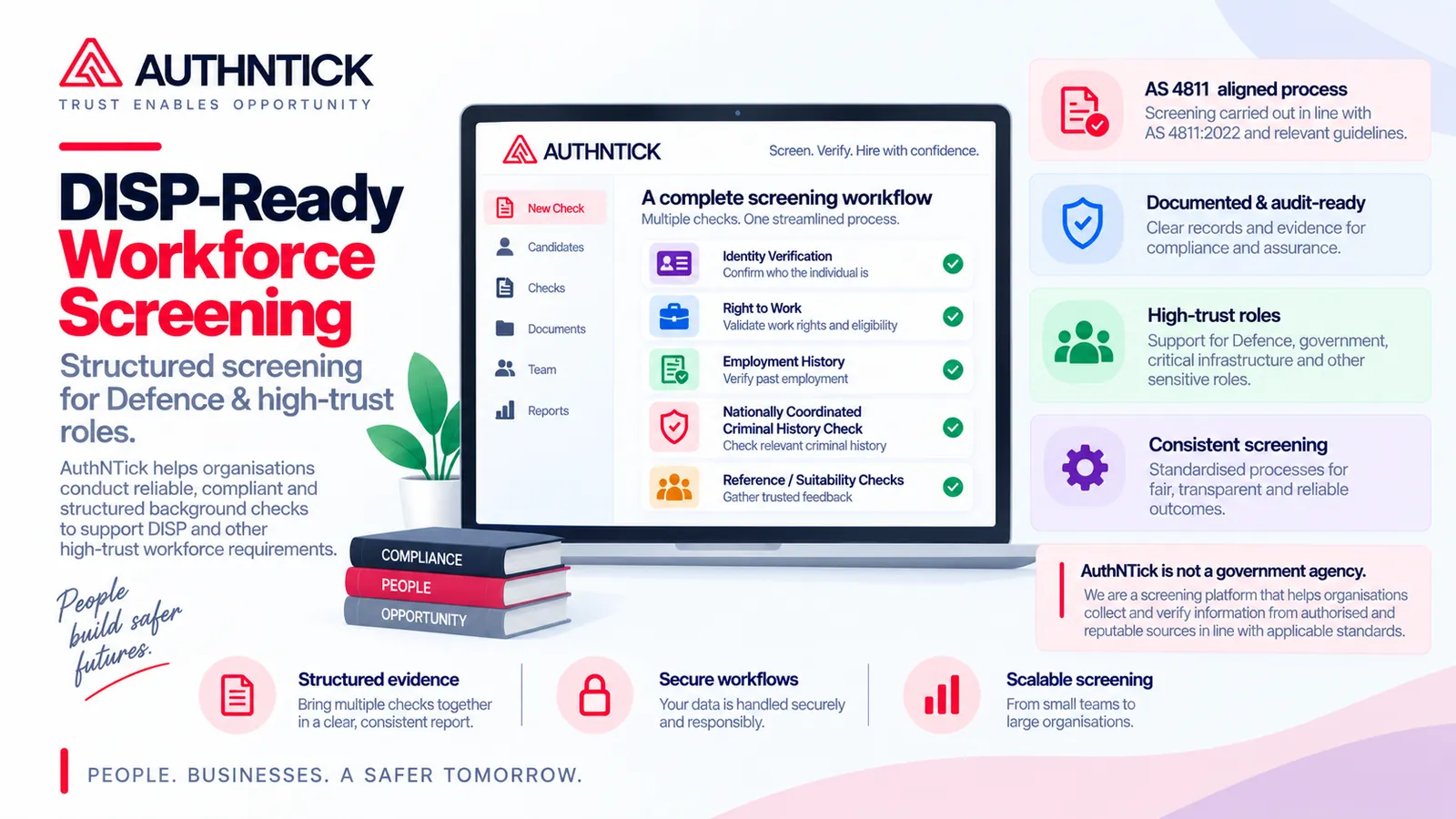
DISP personnel security starts with understanding who will work for your organisation, what they will access and what evidence you need to make an informed decision. Workforce screening helps Defence businesses review that evidence. It is separate from government security vetting, and ordering a background check does not give someone a security clearance.
This guide explains how DISP workforce screening, AS 4811:2022 and Baseline sponsorship fit together. AuthNTick currently sponsors Baseline security clearances only. AGSVA independently conducts security vetting and determines the clearance outcome.
What is DISP?
The Defence Industry Security Program (DISP) is a membership program that helps Australian businesses understand and meet security obligations when participating in Defence tenders, contracts and projects. It sits within the Defence Security Principles Framework (DSPF).
The four DISP security categories
Defence describes four security domains:
- Security governance: responsibility, policies and processes for managing security.
- Personnel security: the suitability and security awareness of people with access to government resources.
- Physical security: protection of people, premises and physical assets.
- ICT and cyber security: protection of systems, networks and the information they hold.
A screening provider supports part of the personnel-security process. A package of checks does not establish compliance across all four domains or guarantee DISP membership. Use Defence’s current DISP eligibility and suitability guidance to understand the membership requirements that apply to your organisation.
DISP personnel security and AS 4811:2022
Defence identifies AS 4811:2022 Workforce Screening as the standard DISP members need to meet. Its guidance covers screening for cleared and non-cleared personnel, contractors and others who will access Australian Government resources. This does not mean every person needs the same commercial background-check package or a security clearance.
For practical workforce screening, start with the position: document the work, access, relevant risks and evidence required. Define who can review results, how discrepancies will be resolved and who makes the final employment or access decision. Keep a record of the evidence and the decision, including any limitations or follow-up actions.
Screening requirements depend on the role, organisation, access requirements, contractual obligations and applicable policies. Refer to the current standard and Defence Security Principles Framework when setting your procedure. AuthNTick checks can support an AS 4811:2022-aligned process; they do not independently certify organisational compliance.
Choosing workforce screening for Defence industry roles
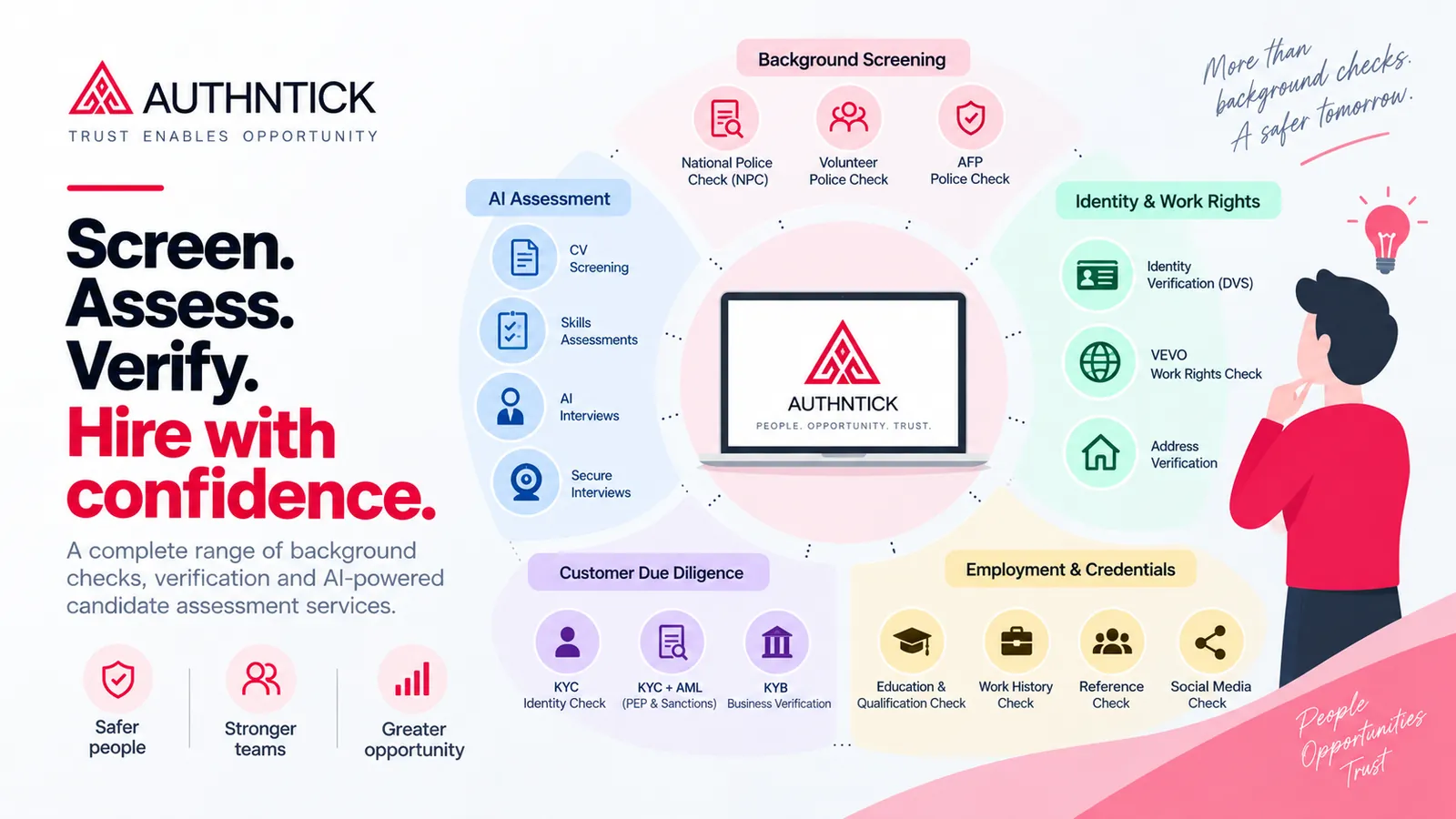
Defence industry background checks should answer specific questions about the role. The following services can supply evidence where relevant; this is not a mandatory checklist for every DISP employee or every Baseline application.
Identity verification
Identity verification and Document Verification Service (DVS) checks help check identity information before reviewing employment history or credentials. An identity result alone does not establish Australian citizenship, work rights or clearance eligibility.
Nationally Coordinated Criminal History Checks
A Nationally Coordinated Criminal History Check provides disclosable criminal-history information for an appropriate purpose. Select the correct check and review the result in its role context. A Nationally Coordinated Criminal History Check does not constitute AGSVA vetting or a complete assessment of a person’s suitability.
Employment and work-history verification
Work history checks help verify relevant employment information and identify gaps or discrepancies that need clarification. Decide which parts of the candidate’s history matter to the position and document information that cannot be verified. Give the candidate an appropriate opportunity to explain inconsistencies.
Education and qualification verification
Education and qualification checks help verify credentials relied on for the role. Consider which qualifications are relevant to the work rather than treating every claimed credential as equally important. Record any outstanding verification before making the hiring decision.
Reference checking
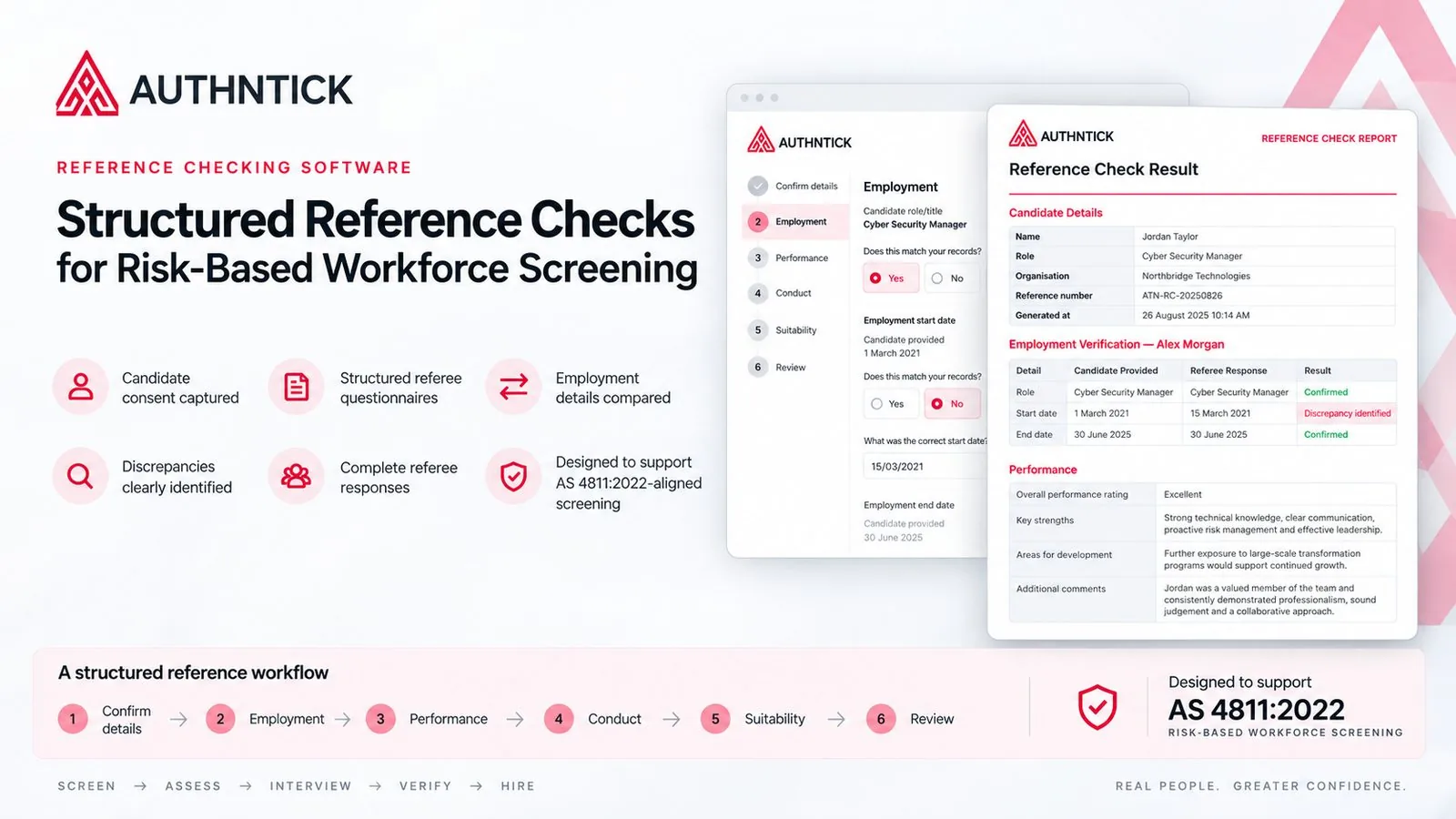
Professional reference checks gather role-relevant employment, performance and conduct information. Use questions linked to the duties and review the referee’s relationship to the candidate. Reference responses are evidence for the employer’s review, not a government security assessment.
VEVO and work rights
VEVO work-rights checks can confirm visa status and applicable work conditions for relevant visa holders. A right-to-work result is distinct from proof of citizenship and does not establish eligibility for an AGSVA clearance.
Address verification
Address verification may help review residential information where it is relevant to the organisation’s screening scope. Agree the evidence and history period required, and review discrepancies in context rather than assuming an unexplained address change is an adverse finding.
Social-media and online-presence screening
Social media checks may be appropriate where online information is relevant to a documented role risk. Define the scope, confirm that information relates to the correct person and give findings human review. Avoid drawing conclusions from unrelated personal information or using online screening as a substitute for official vetting.
Workforce screening and AGSVA security vetting are different
Workforce screening provides information for an organisation’s hiring and personnel decisions. Government security vetting assesses suitability to hold a security clearance. AGSVA conducts that assessment through its own processes, requests the information it needs and determines the clearance outcome. AuthNTick does not grant, issue or approve security clearances.
A Baseline security clearance may support ongoing access to classified resources up to and including PROTECTED where the role requires it. See the AGSVA security clearance definitions. A completed background-check package does not result in a Baseline clearance or replace AGSVA’s assessment.
Baseline security clearance sponsorship through AuthNTick
AuthNTick can assess eligible requests for Baseline security clearance sponsorship where a genuine role or business requirement exists. This can include enquiries from organisations, contractors and professionals who require an appropriate sponsor. Each request is assessed individually.
AuthNTick currently sponsors Baseline security clearances only. AuthNTick does not currently sponsor NV1, NV2 or Positive Vetting clearances. Sponsorship does not guarantee that AGSVA will grant a clearance. Where AuthNTick agrees to sponsor an application, it supports the applicable administration while the applicant proceeds through the official AGSVA process.
A practical process for Defence contractor screening
- Confirm the requirement. Record the role, project, access and contractual conditions. Identify whether a clearance is separately required.
- Set the screening scope. Select relevant checks and define evidence, review responsibilities and discrepancy handling before inviting the candidate.
- Explain the process. Tell the candidate what information will be collected, why it is needed and how it will be handled.
- Review the evidence. Consider results together, clarify unresolved information and document the authorised decision.
- Keep statuses separate. Distinguish completed workforce checks, approved sponsorship, an AGSVA assessment in progress and a clearance outcome.
- Review changes. Revisit requirements when duties or access change, and manage records and departing personnel under your organisation’s policies.
For example, a supplier hiring an engineer may need to verify identity, qualifications and relevant employment history. If the project also needs a Baseline-cleared worker, that requirement follows a separate sponsorship and AGSVA pathway. Completing the employment checks does not authorise access to classified resources.
How AuthNTick supports Defence and government suppliers
AuthNTick helps organisations coordinate role-based checks, candidate invitations and results through its workforce screening platform. Your authorised team remains responsible for choosing appropriate screening and making employment decisions. Our Government & Defence screening page explains how these services fit government and Defence workforce needs.
If a role, organisation or project has a genuine Baseline requirement, tell us about it through the sponsorship enquiry workflow. AuthNTick can assess whether it may be able to provide sponsorship; both sponsorship and clearance approval remain subject to their separate assessments.

About the author
Dev Tripathi
Editorial contributor and cybersecurity adviser
Dev Tripathi is a senior cybersecurity, risk and compliance professional with more than 20 years of experience. At AuthNTick, he contributes to and reviews guidance on Nationally Coordinated Criminal History Checks, identity verification, privacy, information security and workforce compliance.
Editorial references
Official and authoritative sources
Use these primary and authoritative references to confirm current requirements for the topic covered in this guide.
- ACIC service Australian Criminal Intelligence Commission
- How the ACIC service works Australian Criminal Intelligence Commission
- Nationally Coordinated Criminal History Check validity Australian Criminal Intelligence Commission
- AS 4811:2022 Workforce screening Standards Australia
This guide is general information, not legal advice. Government processes and employer requirements can change, so check the linked source and the requesting organisation’s instructions before acting. Read our editorial and corrections policy.
Next step
Ready to move from research to action?
Use AuthNTick to complete secure Australian background checks, or speak with our team if you need the right workflow for your organisation.